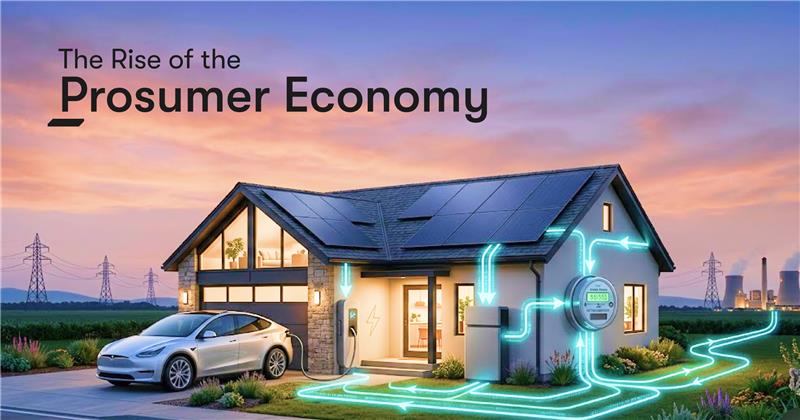
I Own Solar and an EV — Am I a Utility? The Rise of the Prosumer Economy
Published on 31 March 2026




Start saving on your energy bills right now!
Start saving on your energy bills right now!
Be the first one to know everything about smartest ways to save on your energy bills.
For majority of the last century, electricity operated on a largely centralised and predictable model. Large power plants generated electricity, utilities transmitted and distributed it, and households consumed it. The relationship between producer and consumer was clear, distant, and mostly uni-directional. That model is now under visible strain.
The International Renewable Energy Agency reports that the price of solar photovoltaic (PV) modules has dropped by over 90% in the last ten years. Concurrently, electric cars have quickly transitioned from the periphery to the mainstream. Global EV sales exceeded 14 million units in 2023, accounting for close to 18% of new car sales worldwide, as stated by the International Energy Agency (IEA). Adoption of rooftop solar is increasing in tandem with this change; according to IEA projections, the number of homes utilising rooftop solar might increase from approximately 25 million to nearly 100 million by 2030.
These advancements are noteworthy on their own. Together, they imply something deeper: a structural change in how power is produced, controlled, and experienced. Energy is no longer merely something delivered invisibly from distant power plants. At the level of houses, buildings, and communities, it is being produced, stored, and shaped closer to the point of usage.
A new role in the energy system is subtly emerging as this shift gains traction: the prosumer.
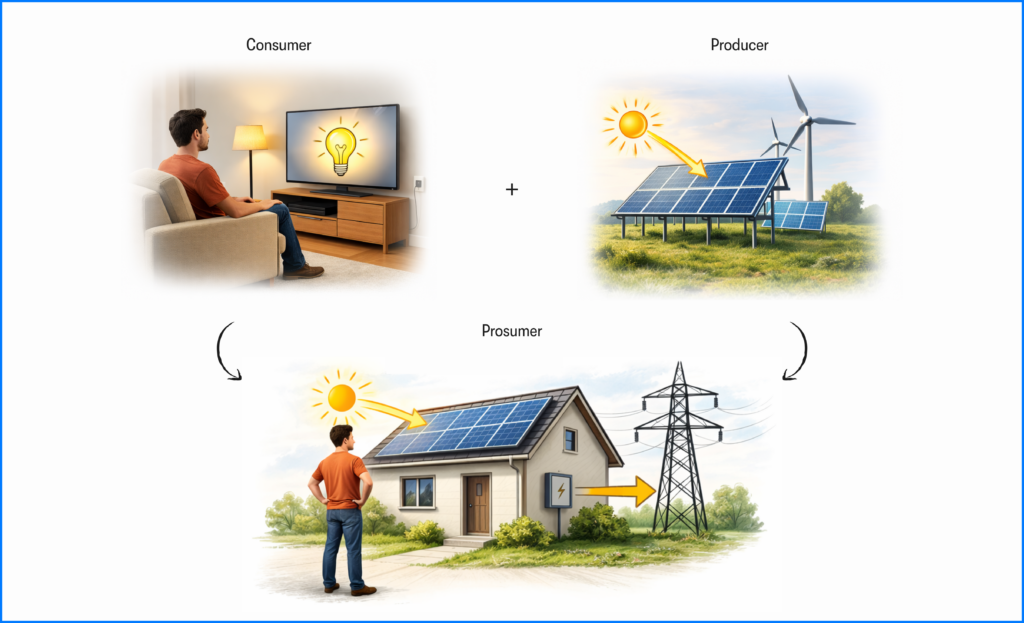
An entity that generates and uses electricity is known as a prosumer. In practical terms, this usually refers to houses that generate power from rooftop solar, consume part of it for their own needs, and, where rules allow, export surplus electricity back to the grid.
What distinguishes today’s prosumer from prior forms of distributed generation is not purpose, but feasibility. Until recently, producing electricity at home was expensive, technically complex, and difficult to incorporate into the wider grid. Falling costs, innovating technology, and new policy frameworks have transformed that equation.
As a result, an increasing number of homes are no longer the power system’s passive endpoints. Instead, they determine when energy is generated, how it is stored, and how it is consumed.
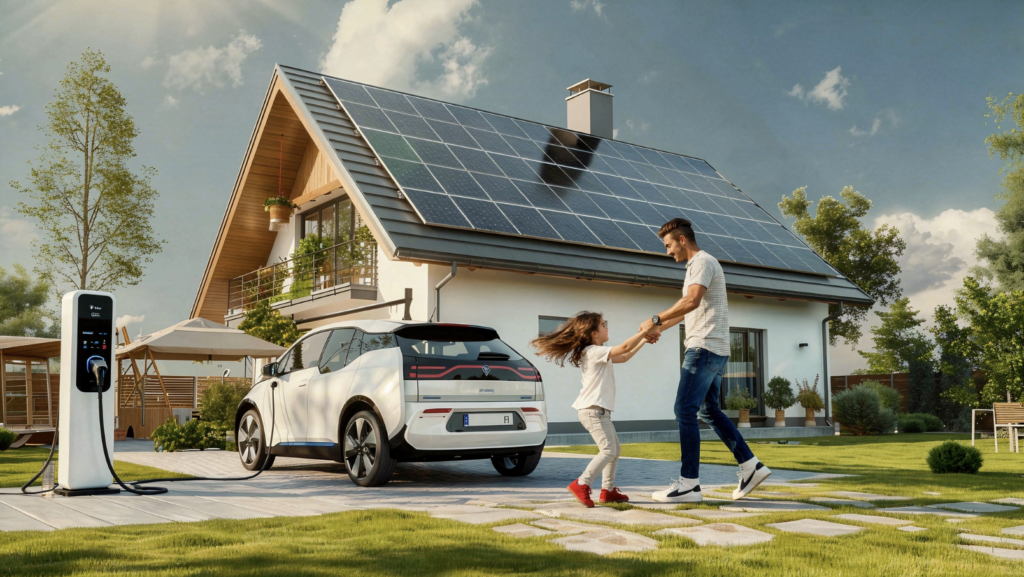
At first look, installing rooftop solar or purchasing an electric vehicle may appear to be separate decisions, one driven by lower electricity bills, the other by greener mobility. But when combined, they radically change how a household interacts with energy.
By enabling the power generation at the point of consumption, solar panels reduce dependence on centralised generation. Although an EV increases demand, it also offers flexibility. Charging doesn’t have to happen right away; it can be planned, postponed, or timed to coincide with times when solar generation is at its peak.
Households with rooftop solar and EV ownership display significantly different consumption patterns, according to research published in ScienceDirect. Their reliance on the grid declines, self-consumption of locally generated electricity increases, and net demand profiles vary, notably during daylight hours when solar output is maximum.
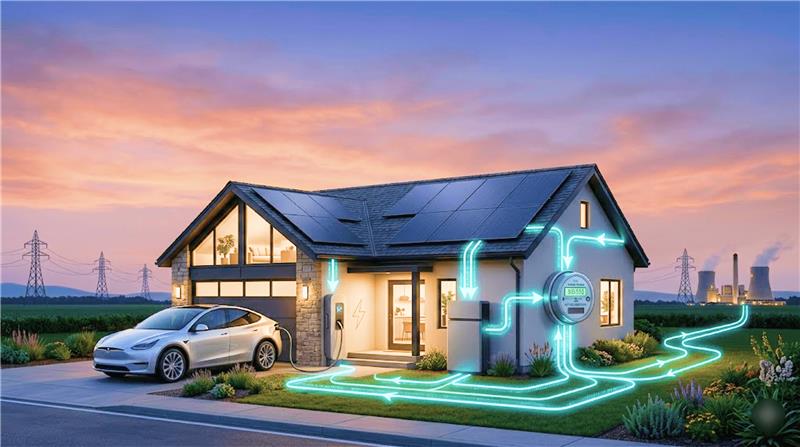
These adjustments could appear small at the level of a single house. They start to change the grid itself at the level of millions of houses. The transfer of electricity from large power plants to customers is no longer one-way. It travels from rooftops to homes, from homes to cars, and increasingly from cars back into the grid, through developing vehicle-to-grid (V2G) technology.
This multi-directional movement is one of the fundamental characteristics of the prosumer economy.
To answer this question, it helps to explore what utilities actually do. Utilities are responsible for generating or acquiring electricity, balancing supply and demand, maintaining infrastructure, and assuring reliable delivery across enormous networks.
A solar-plus-EV household does not replace these functions. On a far smaller scale, though, it starts to resemble some of them. A prosumer family has the ability to produce electricity, store it in an EV or battery, choose when to utilise grid power, and, in certain situations, export excess energy back into the system.
In locations with strong rooftop solar penetration, the combined production of households is already large enough to flatten daily demand peaks. In effect, thousands of small generators function like a distributed power plant.
In regulatory terms, this does not make households utilities. It does, however, indicate that the traditional distinction between producer and consumer is getting more blurred. Households are now active players in the energy system rather than merely end users.
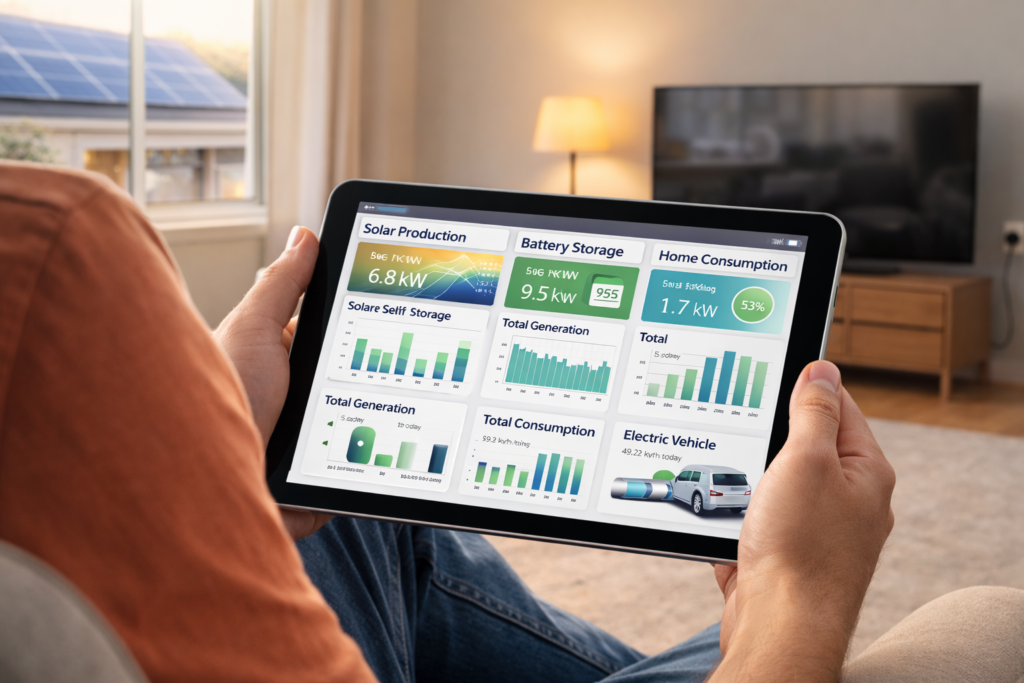
The transition from consumer to prosumer is not driven by solar panels alone. It relies on a physical and digital infrastructure that enables millions of small energy assets to communicate with the grid in a safe and intelligent manner.
Key enabling technologies include:
Advanced Metering Infrastructure (AMI), which allows two-way communication between households and utilities, and offers near real-time visibility into generation and consumption as opposed to monthly snapshots.
Bidirectional meters, which separately measure electricity imported from and exported to the grid, making net metering and net billing technically and legally possible.
Smart inverters, compliant with standards such as IEEE 1547, which regulate voltage and frequency when distributed energy is fed back into the grid, ensuring stability rather than disruption.
Non-Intrusive Load Monitoring (NILM), which helps homes understand inefficiencies without the need for extra hardware by using analytics to infer appliance-level consumption from a single meter.
Home Energy Management Systems, which integrate solar generation, storage, EV charging, and household demand into a single optimisation layer.
AI-driven analytics and forecasting, which translate raw data into insight, projecting demand patterns, finding flexibility, and advising best usage aligned with grid conditions.
New models of power purchase, with the advent of exchange-based and peer-to-peer models, power purchase is also evolving, giving consumers and prosumers greater flexibility when purchasing and selling electricity.
Direct energy transactions are starting to be made easier by digital platforms, which also gradually move procurement away from fixed, utility-led supply systems and increase transparency, price discovery, and choice.
As energy systems become more distributed and data-driven, the role of enabling infrastructure becomes increasingly important. Kimbal contributes to this transition by building the foundational tools that help utilities and energy users better understand and manage electricity flows. While its work began with large-scale deployments of Advanced Metering Infrastructure, Kimbal’s focus has steadily expanded to address the needs of a more dynamic grid, one shaped by renewables, electric vehicles, and emerging prosumers.
Through integrated AMI platforms, communication networks and head-end systems, Kimbal supports deeper visibility into how energy is generated, consumed and managed across the system.
At the same time, Kimbal’s developing Edge Intelligence capabilities are starting to bring intelligence to the edge. As the system grows more dynamic, this strategy aims to enable use cases like network visibility, demand orchestration, and enhanced consumer-level insights by enabling more responsive and distributed decision-making at the grid edge.
As prosumer participation grows, additional system-level difficulties emerge, particularly during periods when distributed generation exceeds local demand.
Rooftop solar power often peaks around midday when residential demand is relatively low. In locations with significant solar penetration, this can lead to temporary oversupply, voltage spike in distribution networks, and, in some wholesale markets, negative electricity prices. In order to preserve stability, utilities might be compelled to reduce generation or export excess power.
When managed effectively, extra energy becomes an opportunity rather than a cost. It can be absorbed by charging EVs during the day, stored in batteries for use during evening peaks, or routed toward flexible industrial and commercial demands. Inefficiencies and grid stress result from poor management.
The prosumer economy does not mean that balancing is no longer necessary. It amplifies the challenge by moving the problem from a small number of massive power plants to millions of distributed individuals whose activities need to be coordinated.
As electricity systems grow more dynamic, value is no longer created only by producing electricity. It is increasingly produced by the way and timing of electricity use.
Prosumers are compensated through mechanisms such as:
These techniques can result in 5–30% yearly electricity cost reductions in a number of markets—not by using more electricity, but by utilising it more wisely. There is no “free” electricity. Rather, it turns into a service shaped by behaviour.
A crucial debate emerges as prosumership grows: should families strive for energy independence or conform to the larger system?
While independence can promote resilience at an individual level, uncoordinated behaviour at scale can create new challenges. When a home optimises only for itself, local networks may become unstable or peak demand may unintentionally rise.
A more sustainable strategy views prosumership as involvement in the grid rather than as detachment from it. Individual optimisation can strengthen rather than weaken collective stability when it is led by transparent pricing signals, shared data, and system-wide visibility.
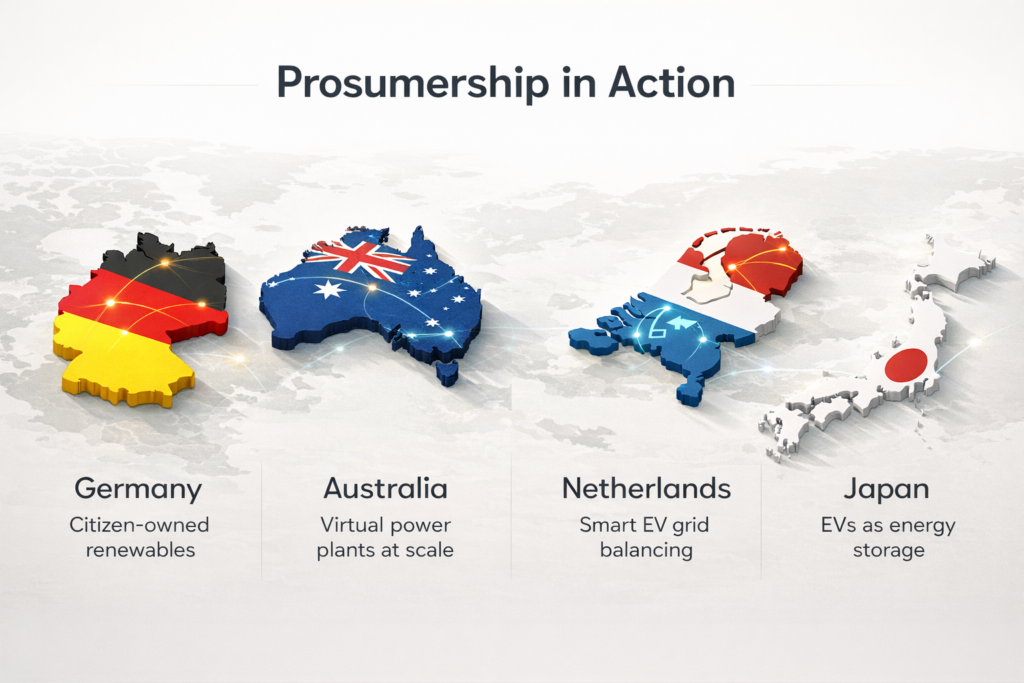
Several countries give early, real-world examples of how prosumership can function at scale when backed by the correct mix of policy, infrastructure, and coordination.
These instances illustrate that prosumership is not experimental. It becomes a reliable and useful part of the energy system when it is supported by careful market design and digital infrastructure.
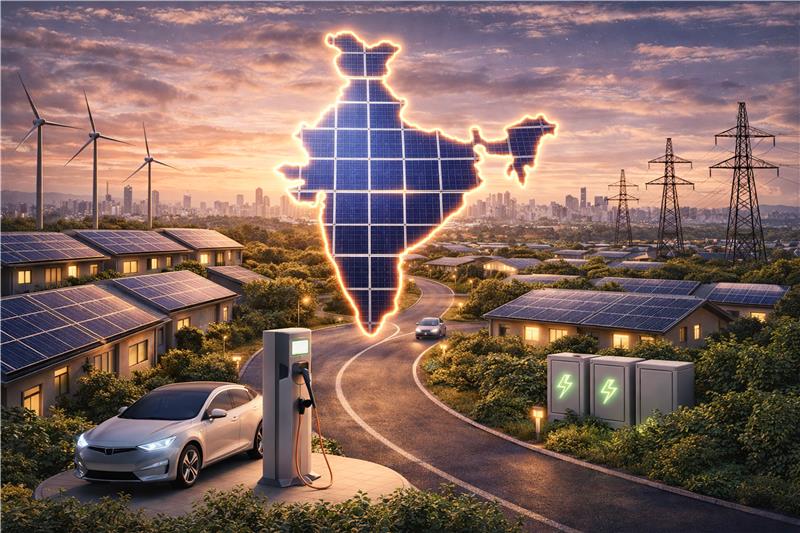
In a country like India, prosumership is not only a lifestyle choice; it is a system-level and strategic consideration.
India’s power consumption is predicted to rise sharply over the next ten years due to fast urbanisation, growing electrification, and growing demand for mobility and cooling, with demand likely to nearly double by 2030, according to International Energy Agency predictions. With over 300 million households, even partial adoption of rooftop solar and flexible demand may significantly reduce pressure on new generation capacity, transmission expansion, and fossil-fuel dependence.
Government initiatives such as PM Surya Ghar: Muft Bijli Yojana, which aims to solarise 10 million households by 2027, reflect a growing recognition that distributed participation is essential for meeting future energy needs.
Widespread prosumership cannot operate at the national level through standalone or fragmented systems. To manage millions of distributed generators, storage resources, and flexible loads within a single, reliable framework, a unified grid is necessary.
Common frequency and voltage standards are provided by India’s national grid, which also makes it possible to absorb excess renewable energy from one area into another. Grid operators are able to predict renewable variability and changing demand patterns due to advanced forecasting, which is increasingly aided by artificial intelligence.
In this scenario, One Grid encourages decentralisation rather than restricting it, ensuring that prosumer participation strengthens rather than disrupts the electricity grid.
If you own solar panels along with an EV, you are no longer a passive energy consumer. You can generate power, contribute to demand response, and occasionally support the grid. You are unquestionably a member of the energy ecosystem even though you are not a utility in the traditional sense.
Technology is not the only factor contributing to the prosumer economy’s growth. Participation is what fuels it, and intelligent infrastructure, coordinated systems, and compatible incentives support it.
The question is no longer whether households will shape the future of energy, but how wisely that engagement is planned, so that individual choices and system stability advance together.
This blog explores the rise of the prosumer economy, where households are no longer just consumers of electricity but active participants in generating, storing, and managing it.
It explains how technologies like rooftop solar, electric vehicles, and smart energy systems are reshaping traditional power models, making energy more decentralised, dynamic, and user-driven.
1. What is a prosumer in the energy context?
A prosumer is someone who both produces and consumes electricity, typically using rooftop solar and sometimes exporting surplus power to the grid.
2. Does owning solar panels make me independent from the grid?
Not entirely. While solar reduces reliance on the grid, most households still depend on it for backup, stability, and energy exchange.
3. How does an EV contribute to the prosumer economy?
An EV acts as a flexible load and, in some cases, as storage (via vehicle-to-grid), allowing energy to be used, stored, or even supplied back to the grid.
4. What are the financial benefits of being a prosumer?
Benefits include reduced electricity bills, earnings from surplus energy (net metering/billing), and savings through smart energy usage patterns.
5. Is prosumership scalable at a national level?
Yes, but it requires strong grid infrastructure, smart metering, policy support, and coordinated energy management systems.
6. Will prosumers replace traditional utilities?
No. Prosumers complement utilities by decentralising energy generation, but utilities remain essential for grid stability and large-scale operations.
Your email address will not be published. Required fields are marked *