Kimbal Growth Story Q4 FY2025-26: From Engineering Depth to New Frontiers
Published on 22 April 2026




Start saving on your energy bills right now!
Start saving on your energy bills right now!
Be the first one to know everything about smartest ways to save on your energy bills.
Climate change is often discussed in terms of global policies, industrial emissions, and technological breakthroughs. But there is another powerful factor that shapes environmental outcomes: how people live every day.
This idea sits at the heart of Mission LiFE, a global movement introduced by Narendra Modi at COP26.
Mission LiFE reframes climate action as something that individuals, communities, and societies can participate in collectively. Instead of focusing only on large-scale policy or technological solutions, the initiative emphasizes a shift from mindless consumption to mindful utilisation.
The goal is ambitious: encourage one billion people worldwide to adopt sustainable lifestyles by 2028 and build a global community of Pro-Planet People (P3).
Mission LiFE starts with a simple but powerful idea: Climate action should not remain confined to policy rooms. It should become a people’s movement.
For decades, climate discussions focused on industrial emissions and technological innovation. While these remain critical, consumption patterns and lifestyle choices also play a major role in environmental impact.
Mission LiFE encourages individuals to rethink everyday decisions such as:
Small actions, when adopted at scale, can create large systemic shifts.
One of the unique aspects of Mission LiFE is that it draws inspiration from traditional Indian lifestyle practices.
For centuries, Indian culture has emphasized:
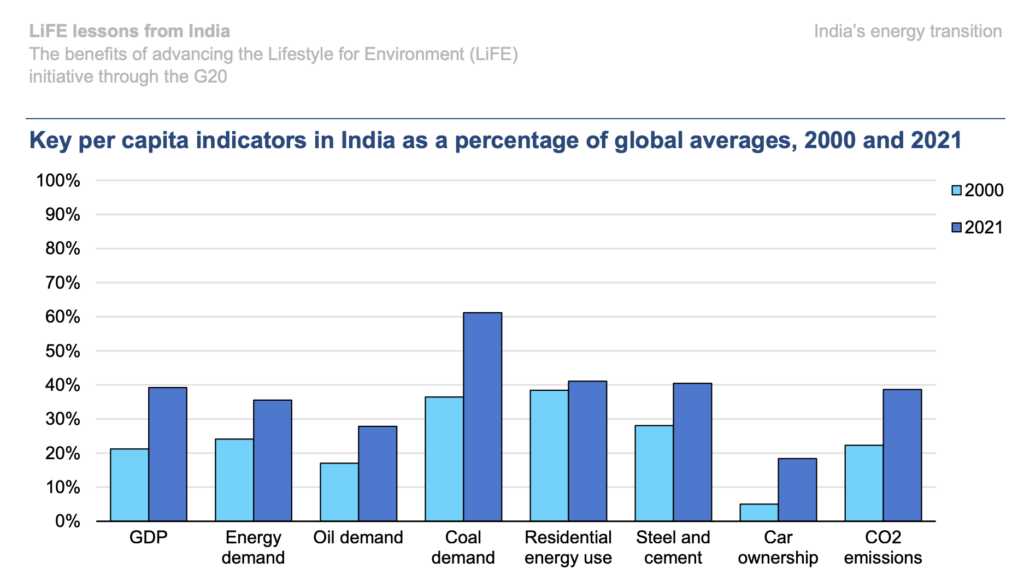
These values have practical environmental outcomes. India’s per-capita carbon footprint is nearly 60% lower than the global average, partly due to lifestyle patterns shaped by cultural traditions.
Mission LiFE seeks to scale this philosophy globally by demonstrating that sustainability can be rooted in everyday living rather than only in advanced technologies.
Ancient Indian philosophy describes nature through the concept of the five elements (Panchamahabhutas):
| Element | Traditional Meaning | Modern Sustainability Practice |
| Prithvi (Earth) | Source of life and nourishment | Organic farming, soil conservation |
| Jala (Water) | Sacred and life-sustaining | Rainwater harvesting, efficient irrigation |
| Vayu (Air) | Breath of life | Reducing air pollution and emissions |
| Agni (Energy) | Transformative energy | Renewable energy and efficient cooking |
| Akasha (Space) | Interconnectedness | Biodiversity protection |
This philosophy views humans not as owners of nature but as participants within an ecological system.
Sustainable living is also reflected in the Traditional Ecological Knowledge (TEK) of India’s indigenous communities.
Tribal groups such as the Khasi, Gond, and Santhal have long practiced:
These practices align closely with several United Nations Sustainable Development Goals, including climate action, biodiversity protection, and food security.
They show that sustainability can be deeply embedded in cultural practices rather than imposed through modern regulations alone.
Mission LiFE follows a structured pathway designed to convert individual behaviour into systemic change.
Phase 1: Change in Demand
The first phase focuses on encouraging individuals to adopt sustainable habits.
Examples include:
With nearly 8 billion people on Earth, even small lifestyle shifts can generate significant environmental impact.
Phase 2: Change in Supply
As consumer demand changes, markets and industries respond.
Businesses begin offering:
In this phase, consumer behaviour drives innovation.
Phase 3: Change in Policy
Once demand and supply start shifting, governments and institutions introduce supportive policies.
These may include:
At this stage, behavioural change becomes institutional transformation.
Behavioural Science Behind Mission LiFE
Mission LiFE also draws on behavioural economics and Nudge Theory.
Instead of forcing people to adopt sustainable practices, it focuses on subtle incentives and design choices that make sustainable behaviour easier.
Key mechanisms include:
Default Options
People often stick with default settings. For example, when food delivery apps set “no cutlery” as the default, eco-friendly orders increased dramatically in several cities.
Humans are strongly influenced by peer behaviour. The concept of Pro-Planet People (P3) helps make sustainability a social identity rather than a sacrifice.
Gamification
Initiatives like the 21-Day LiFE Challenge encourage individuals to build sustainable habits through daily actions.
Real-Time Feedback
Smart meters and energy dashboards allow people to see how their consumption affects the environment, making abstract climate impacts more tangible.
Mission LiFE identifies 75 lifestyle actions grouped into seven themes:
Each theme focuses on simple habits that can be adopted without major infrastructure changes.
The philosophy remains consistent:
Small habits can create large environmental impact.
India offers several examples of sustainable practices that Mission LiFE highlights.
Water Management
Traditional water systems such as johads, stepwells, and tank irrigation systemshelped communities store and conserve water long before modern technology.
Repair and Reuse Culture
Practices like rafu (fabric repair) and kantha quilting extended the life of clothing and reduced waste.
Natural Cooling Systems
Earthen pots or matkas use evaporative cooling to keep water cool without electricity.
These examples demonstrate how low-energy solutions can meet everyday needs sustainably.
Food systems are a major contributor to global emissions.
Mission LiFE encourages dietary shifts toward local, seasonal, and traditional foods.
Millets, often referred to as “Shree Anna”, are central to this approach because they:
Promoting such crops can improve both food security and climate resilience.
A common debate in climate discussions is whether individual action matters compared to systemic reforms.
Recent research suggests the two are not mutually exclusive.
Individual actions can:
1. Signal demand to markets
2. Normalize sustainable behaviourswithin communities
3. Create pressure for policy changes
In other words, systemic change often begins with cultural change.
Mission LiFE has gained international recognition, particularly during India’s G20 presidency under the theme:
“One Earth, One Family, One Future.”
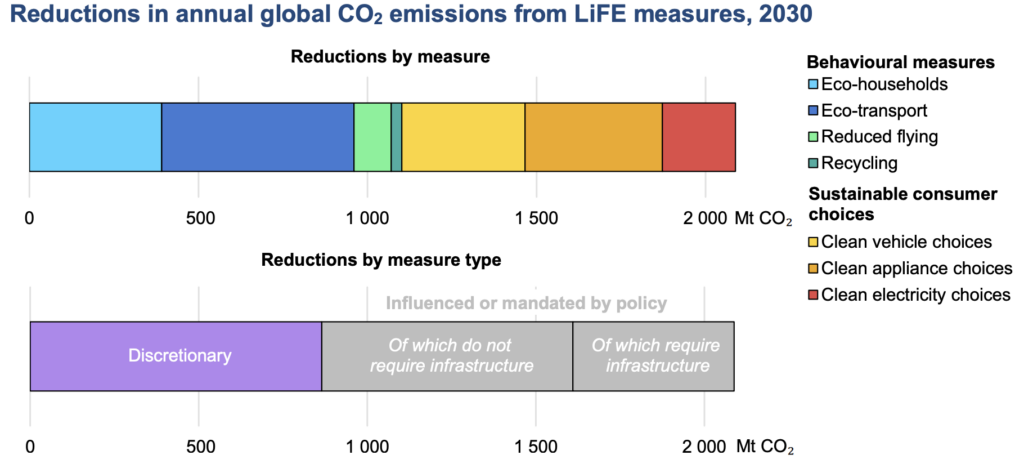
According to analysis by the International Energy Agency, widespread adoption of lifestyle changes promoted under Mission LiFE could reduce global carbon emissions by more than 2 billion tonnes annually by 2030.
This would represent a significant contribution toward achieving global climate targets.
Climate change is often framed as a technological or political challenge. Mission LiFE reminds us that it is also a cultural and behavioural challenge.
When individuals choose to save energy, reduce waste, and live responsibly, those actions ripple outward – influencing markets, policies, and global systems.
In that sense, sustainable development is not only about changing how we produce energy or goods.
It is also about changing how we live.
What is Mission LiFE?
Mission LiFE (Lifestyle for Environment) is a global initiative launched by India that encourages individuals to adopt sustainable lifestyles to help address climate change.
Why does Mission LiFE focus on individual behaviour?
Lifestyle choices influence energy consumption, waste generation, and resource use. When adopted collectively, behavioural changes can significantly reduce environmental impact.
What are Pro-Planet People (P3)?
Pro-Planet People are individuals who consciously adopt environmentally responsible behaviours in their daily lives.
How can individuals participate in Mission LiFE?
People can contribute by adopting simple habits such as saving energy, reducing plastic use, conserving water, repairing products, and choosing sustainable foods.
What is the global goal of Mission LiFE?
The initiative aims to inspire one billion people worldwide to adopt sustainable lifestyles by 2028.
Official Government of India Frameworks:
International Reports and Policy Analysis:
“Supporting Institutional Knowledge Development for Mainstreaming Mission LiFE,” CSIR
Your email address will not be published. Required fields are marked *