
Kimbal Participates in Metering India 2026, Highlighting the Need to Strengthen India’s Smart Metering Ecosystem
Published on 13 October 2026




As renewable energy capacity continues to grow, one challenge becomes more important than ever: how do we store electricity when the sun is shining or the wind is blowing, and use it when people actually need it?
The answer increasingly lies in battery energy storage systems (BESS).
According to the IEA’s latest report, battery storage reached another milestone in 2025. New installations broke global records, deployment expanded into new markets, costs continued to decline, and batteries started playing a much bigger role in balancing electricity grids. For utilities, smart metering companies, grid operators, policymakers, and energy technology providers, this is more than just another industry update. It signals how electricity systems are evolving to become more flexible, digital, and renewable-ready.
Battery deployment grew rapidly across the world in 2025. According to the report by IEA,
This level of annual growth even surpassed the highest yearly expansion ever recorded for gas-fired power generation capacity. Battery storage has moved from an emerging technology to a critical part of modern electricity infrastructure.
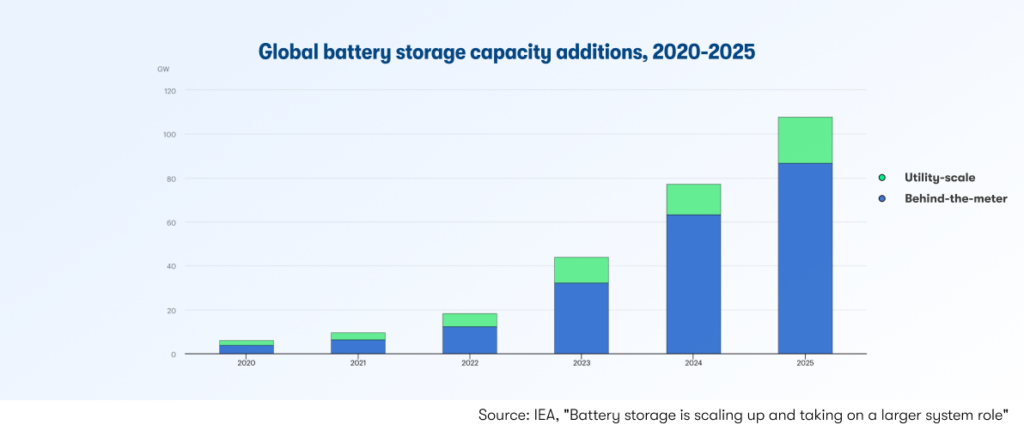
Renewable energy does not produce electricity at a constant rate. Solar panels generate electricity during the day. Wind farms depend on weather conditions. Electricity demand, however, changes throughout the day. Battery storage solves this challenge by storing electricity when renewable generation is high and supplying it back to the grid during peak demand. This improves,
Instead of treating batteries as backup equipment, power systems now use them as an active grid resource.
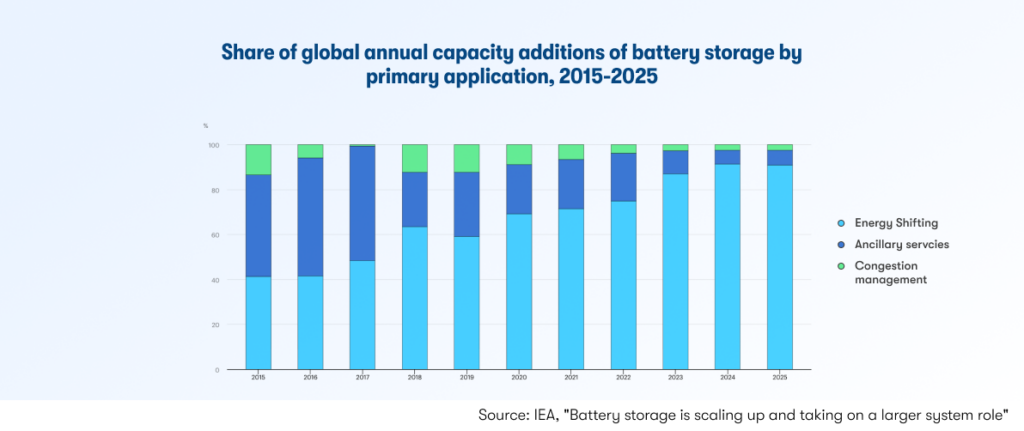
One of the biggest findings from the IEA report is that batteries now perform multiple functions simultaneously. Modern battery systems can,
Battery projects now generate value through multiple services. This makes investments more attractive for utilities and developers.
A decade ago, many battery projects focused on providing fast-response grid services such as frequency regulation. Today, the biggest opportunity is energy shifting. Energy shifting means storing electricity during periods of high renewable generation and delivering it later when demand increases. According to the IEA,
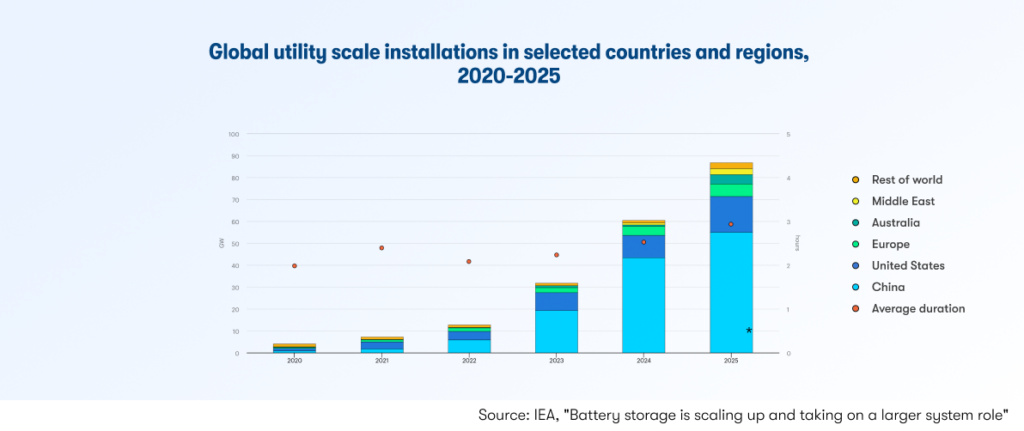
At the same time, battery systems have become larger and can store electricity for longer periods. The average storage duration of new utility-scale projects increased from around two hours in 2023 to three hours in 2025, with more projects offering four hours or longer. This trend reflects the growing need to support higher shares of solar and wind generation.
China remained the world’s largest battery storage market in 2025. The country added more than 63 GW of new battery capacity, including large utility-scale projects and distributed storage systems. The United States followed with 19 GW of additions, while Europe installed around 6.2 GW, with a strong shift toward utility-scale deployments. Several emerging markets also recorded remarkable growth.
Australia became one of the fastest-growing battery storage markets. The country installed nearly 8 GW of new battery capacity in 2025, almost nine times more than the previous year. Battery storage now represents around 18% of Australia’s installed dispatchable generation capacity, highlighting its central role in grid operations.
Saudi Arabia emerged as one of the fastest-growing battery markets in the Middle East. Large-scale projects now support the country’s expanding renewable energy programme and provide additional flexibility for the power system.
Chile continued investing in utility-scale batteries to capture surplus solar generation during the day and deliver electricity during evening demand peaks. These examples show that battery deployment is expanding well beyond traditional early adopters.
Battery prices have changed dramatically over the past decade. The IEA reports that battery costs have fallen by more than 90% between 2010 and 2025. Several factors contributed to this decline,
Lower costs have improved the business case for utilities, industries, commercial buildings, and renewable energy developers. As battery economics continue to improve, more projects become financially viable without relying heavily on subsidies.
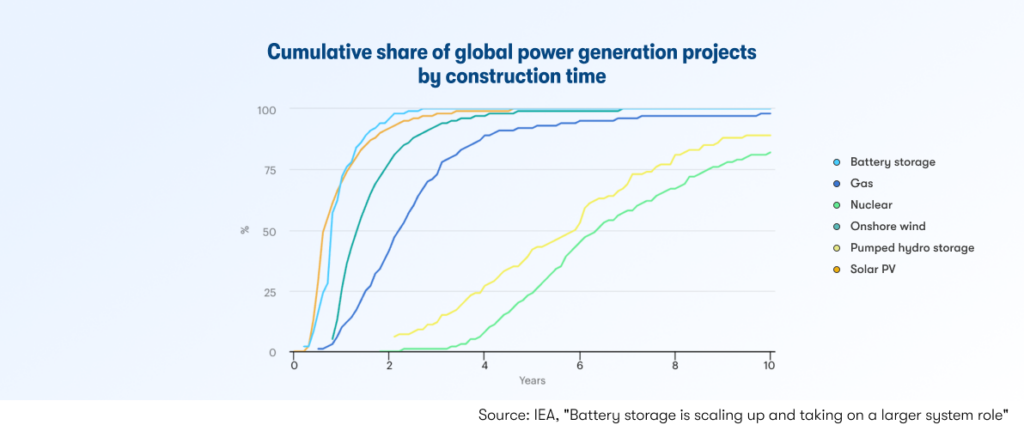
Speed has become another major advantage. Utility-scale battery projects typically require around 275 days for construction. Solar projects require similar timelines. By comparison, gas-fired plants and large infrastructure projects often take several years to become operational. This shorter development cycle allows utilities to respond much faster to growing electricity demand and renewable integration requirements. The report also highlights that permitting and grid connection often take longer than actual construction. Improving these processes could further accelerate deployment.
Perhaps the most interesting part of the report is how batteries now support day-to-day grid operations.
California has installed more than 17 GW of battery capacity. On 29 March 2026, batteries supplied over 40% of the state’s electricity demand during the evening peak. Battery systems now contribute more than 60% of the state’s hourly ramping requirements, helping the grid respond quickly as solar generation declines after sunset.
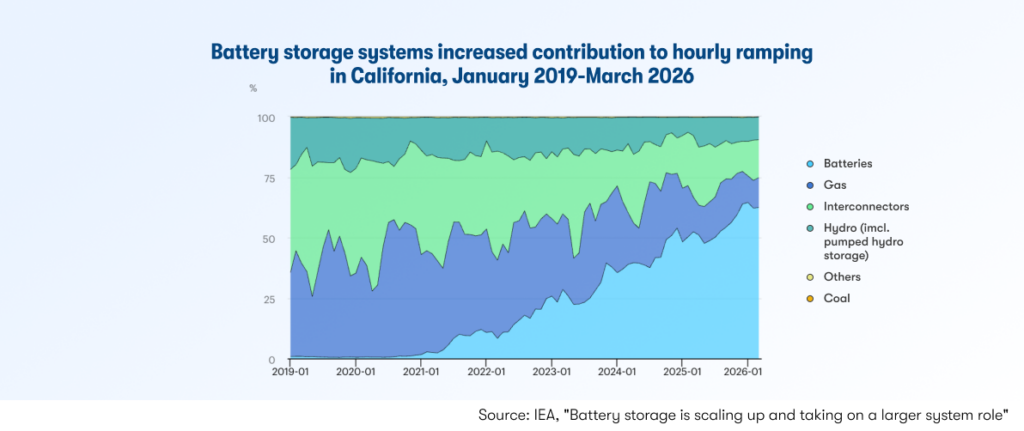
Battery systems supplied more than 40% of hourly ramping needs in the ERCOT market during April 2026.
With one of the world’s highest shares of renewable energy, batteries already contribute more than 30% of hourly ramping requirements during several months of the year. These examples demonstrate how battery storage has become an operational asset rather than a backup technology.
India continues expanding renewable energy capacity through solar, wind, and other clean energy sources. As renewable generation grows, flexible infrastructure becomes increasingly important. Battery storage will help India,
For India’s electricity ecosystem, battery storage and digital grid technologies will increasingly work together.
This is where technologies such as smart meters, Advanced Metering Infrastructure (AMI), and real-time grid monitoring become even more valuable.
Smart meters provide detailed consumption data, while battery systems add operational flexibility. Together, they enable utilities to make faster and more informed decisions, improve demand management, and build a more resilient electricity network.
Battery storage has entered a new phase of global adoption, becoming an essential part of modern power systems. It is helping utilities in supporting renewable integration, improving grid flexibility, balancing electricity demand, and strengthening energy security. The IEA’s latest findings show that countries investing in battery storage today are building electricity systems that can respond faster, operate more efficiently, and support higher levels of clean energy.
For India’s energy sector, this presents a significant opportunity. As smart grids, renewable energy, and digital infrastructure continue to expand, battery storage will become one of the key technologies shaping the future of power.
Learn more: Smart Meters in India Explained: Benefits, Prepaid Model, and RDSS Guide (2026)
What is battery energy storage?
Battery energy storage is a system that stores electricity for later use. It charges when electricity supply is high and releases power when demand increases.
Why is battery storage important for renewable energy?
Solar and wind generation depend on weather conditions. Battery storage stores surplus renewable electricity and delivers it when generation falls or demand rises, making renewable energy more reliable.
How does battery storage support smart grids?
Battery storage helps balance electricity supply and demand in real time. Combined with smart meters and AMI, it enables utilities to optimise grid operations, improve reliability, and integrate more renewable energy.
What is energy shifting?
Energy shifting refers to storing electricity during periods of excess generation and using it later during peak demand. It has become the primary application for modern battery storage systems.
Which countries are leading battery storage deployment?
China, the United States, and Europe continue to lead in total installed capacity, while Australia, Saudi Arabia, and Chile recorded some of the fastest growth rates in 2025.
How do smart meters complement battery storage?
Smart meters provide real-time consumption data, while battery systems provide operational flexibility. Together, they help utilities improve demand response, optimise grid performance, and integrate distributed energy resources more efficiently.
What role can battery storage play in India’s energy transition?
Battery storage can help India integrate more renewable energy, reduce peak demand pressure, improve grid resilience, support distributed energy resources, and strengthen future-ready smart grids.
Published on 13 October 2026

Published on 7 October 2026

Published on 6 October 2026
Your email address will not be published. Required fields are marked *