
Kimbal Participates in Metering India 2026, Highlighting the Need to Strengthen India’s Smart Metering Ecosystem
Published on 13 October 2026




Ever wondered what 1 unit of electricity actually means on your bill? A unit of electricity is measured in kilowatt-hours (kWh) and helps track your electricity consumption units at home. Understanding electricity unit calculation makes it easier to estimate appliance usage, reduce wastage, and manage monthly power costs. In this guide, we explain kWh in electricity, how units are calculated, and how smart meters help monitor real-time consumption.
You’ve probably seen it at the bottom of your electricity bill every month, “Units Consumed: 312”, and thought, what exactly am I being charged for?
You’re not alone. Most of us pay our electricity bills without really understanding what a “unit” means or how it adds up. This guide breaks it down in plain language, no engineering degree required.
A unit of electricity is simply a measure of how much electricity you use.
1 Unit of Electricity = 1 kilowatt-hour (kWh)
This essentially means that, if you use 1000 watts (1 kW) of power for 1 hour, you consume 1 unit of electricity.
In simple terms:
| Appliance | Power Rating | Run Time | Units Used |
| 100W Bulb | 100 watts | 10 hours | 1 unit |
| 1000W Iron | 1000 watts | 1 hour | 1 unit |
| 2000W Heater | 2000 watts | 30 minutes | 1 unit |
1 unit of electricity means 1 kilowatt-hour (kWh), which is the amount of electricity consumed when a 1000-watt appliance runs for 1 hour.
Same unit, very different appliances – because what matters is power × time, not just the appliance itself.
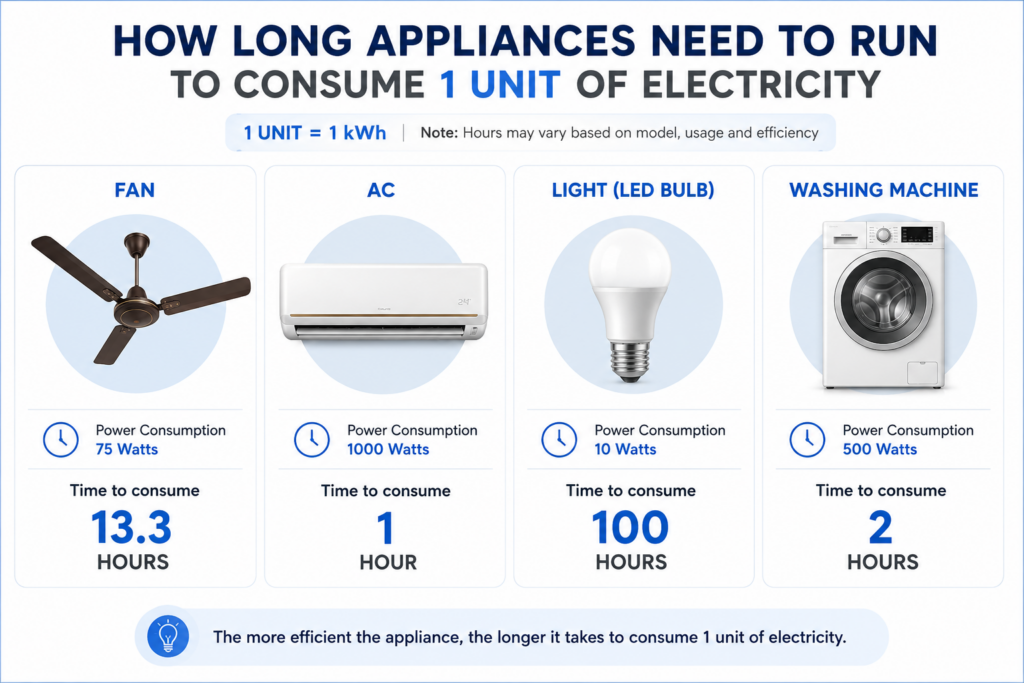
Because electricity companies charge you based on how much energy you consumed, not just how many appliances you ran. A 5-star AC and an old 3-star AC both cool your room but one does it using far fewer units.
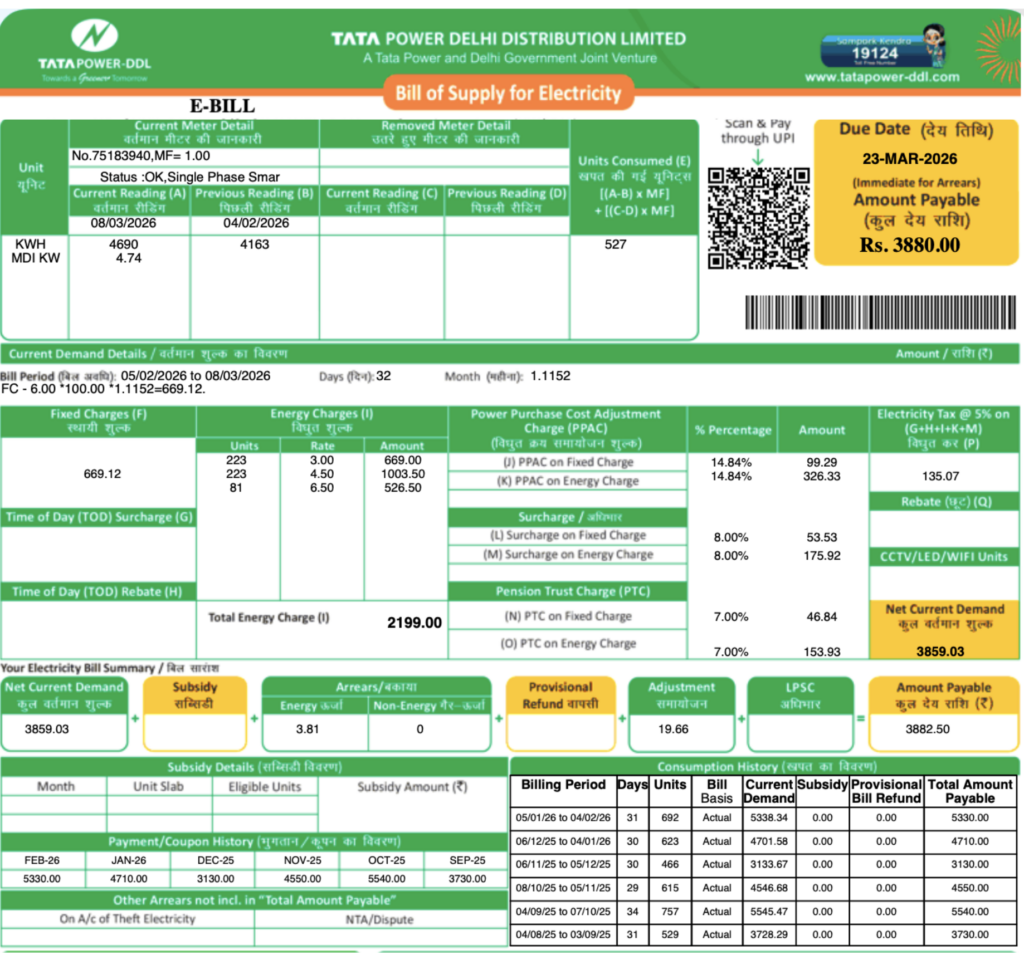
That’s why your bill shows:
The more units you use, the higher your bill. Simple as that.
You don’t need an app to estimate your usage. Here’s the formula:
Units used = (Wattage × Hours Used per Day) ÷ 1,000
For example, your geyser: A 1,500W geyser used for 2 hours a day:
Assuming that the electricity rate in your state is ₹6 per unit, that’s ₹540 just from your morning hot water.
We can use this formula to calculate and understand our daily energy consumption at home.
Here’s a quick reference to help you understand your monthly usage better:
| Appliance | Power | Daily Use | Monthly Units |
| LED Bulb | 10W | 8 hrs | 2.4 units |
| Fan | 75W | 10 hrs | 22.5 units |
| AC (1.5 Ton) | 1500W | 8 hrs | 360 units |
| Refrigerator | 200W | 24 hrs | 144 units |
| Washing Machine | 500W | 1 hr | 15 units |
This is why your electricity consumption depends not just on the power used but also on the duration for which the appliance was used for.
Use the calculator below to know your monthly consumption and estimated cost:
What Does Electricity Cost Per Unit in India? Click here to learn more
When you understand electricity units, you can:
Learn more: Smart Meter Installation Process in India: Complete Guide 2026
Earlier, consumers only saw their electricity usage towards the end of the month.
Until recently, most Indian households only found out how many units they’d used when the meter reader came at the end of the month. By then, it was too late to do anything about it.
Smart meters change this completely. They record your consumption in real time and send the data directly to your electricity provider – no manual readings, no estimated bills. Many smart meters also connect to apps, so you can see exactly how many units you’ve used today, this week, or this month.
Think of it like checking your mobile data usage before you run out, except for electricity.
This is part of why the Indian government wants to replace every traditional meter with a smart meter under the RDSS (Revamped Distribution Sector Scheme). Under the scheme, the government plans to roll out 250 million smart meters by 2027.
Learn how smart meters help track electricity usage in real time.
Once you understand units, your electricity bill stops being a mystery. You’ll start to see patterns. That bill may jump in May because the AC ran longer, or that your geyser consumes much more energy if left on standby.
And most importantly, when you can measure something, you can manage it better.
Discover how smart grids are making power distribution smarter and more efficient.
___________________________________________________________________________________
1. What is 1 unit of electricity equal to?
1 unit of electricity is equal to 1 kilowatt-hour (kWh). It means using 1000 watts of electricity for 1 hour.
2. How many watts are there in 1 unit of electricity?
1 unit = 1000 watts used for 1 hour or 1 kilowatt/hour (kWh)
For example:
3. Why is electricity measured in units?
Electricity is measured in units to track how much energy one consumes. Your electricity bill is calculated based on the number of units consumed.
4. How can I calculate my electricity units at home?
Use this simple formula: Units = (Wattage × Hours Used) ÷ 1000
For example: A 1000W appliance used for 2 hours
(1000W × 2 hours) ÷ 1000 = 2 units
5. Which appliances consume the most electricity units?
Typically, these appliances consume the most units as they consumer higher power as compared to other devices: Air conditioners, geysers, heaters, refrigerators, washing
6. How many units does an AC consume per day?
A 1.5-ton AC typically consumes 1.2 to 1.5 units per hour depending on device efficiency and usage.
Suppose you use it for 8 hours daily: 1.5 units × 8 hours = 12 units per day (approx.)
7. How can I reduce electricity units at home?
You can reduce electricity units by:
Learn more: Smart Meters in India Explained: Benefits, Prepaid Model, and RDSS Guide (2026)
8. How do smart meters help track electricity units?
Smart energy meters are an upgrade to traditional meters; they track electricity units consumed in real-time. The data collected is automatically transmitted to utilities. Smart meters are supported with apps, which helps consumers keep track of their consumption at any given point in time. They make electricity usage transparent and easy to understand and manage for consumers.
Learn more: Smart Meter Myths vs Facts: What Electricity Consumers Need to Know
9. What is the price of 1 kWh in India?
Different states follow a “slab system” where the price per unit increases as your total consumption increases. Here are the estimated per unit rate across sates:
Note: The prices are estimated as per the statistics available on data.gov.in and may vary due to government regulations, subsidies, or changing market trends.
Understand your electricity bill costs and what drives higher monthly charges.
10. What is the difference between Watt, kW, and kWh?
Watt (W) measures electrical power, while kilowatt (kW) equals 1000 watts. Kilowatt-hour (kWh) measures energy consumption over time and is what electricity bills use to calculate units consumed.
11. Which appliances consume the most electricity units?
High-power appliances like air conditioners, geysers, heaters, refrigerators, and washing machines typically consume the most electricity units due to longer usage and higher wattage.
This blog is designed to be simple and useful for everyone, it will be helpful to

Published on 13 October 2026

Published on 7 October 2026

Published on 6 October 2026
Your email address will not be published. Required fields are marked *