

Solar Power Made Simple: Benefits, Usage, the Prosumer Advantage, and Net Metering Explained
Published on 10 June 2026




Start saving on your energy bills right now!
Start saving on your energy bills right now!
Be the first one to know everything about smartest ways to save on your energy bills.
Kimbal Edge Intelligence (Kimbal EI) is Kimbal’s next-generation software platform that transforms smart meters into programmable, app-ready devices capable of running Edge AI and advanced energy applications directly at the grid edge. This blog explains how Kimbal EI accelerates AMI innovation, enables faster deployment of new services, and supports the transition to a more intelligent, flexible, and resilient energy ecosystem.
As one of India’s trusted leaders in Energy Engineering, Kimbal, ships over 12.5 million smart meters annually and is playing a key role in the country’s ambitious smart metering rollout and Advanced Metering Infrastructure (AMI) deployment plan of 250 million endpoints by 2028.
Kimbal Edge Intelligence (Kimbal EI) is Kimbal’s next-generation software platform for smart meters. It turns traditional smart meters into intelligent, app-ready devices that can run advanced applications, Edge AI models, and utility-specific services directly at the grid edge. With Kimbal EI, utilities can deploy new features faster, update applications remotely, and unlock new capabilities such as predictive maintenance, energy analytics, and behind-the-meter energy management without changing the underlying hardware.
As utilities in India and abroad demand smarter, more flexible solutions that can adapt to evolving regulations and customer expectations, Kimbal recognized the need to rethink its software strategy. To lead this shift, the company selected MicroEJ’s platform to decouple software from hardware, enabling the agility of modern software at the grid edge. This enables faster feature development, easier maintenance, and immediate reuse of applications across Kimbal’s product lines.
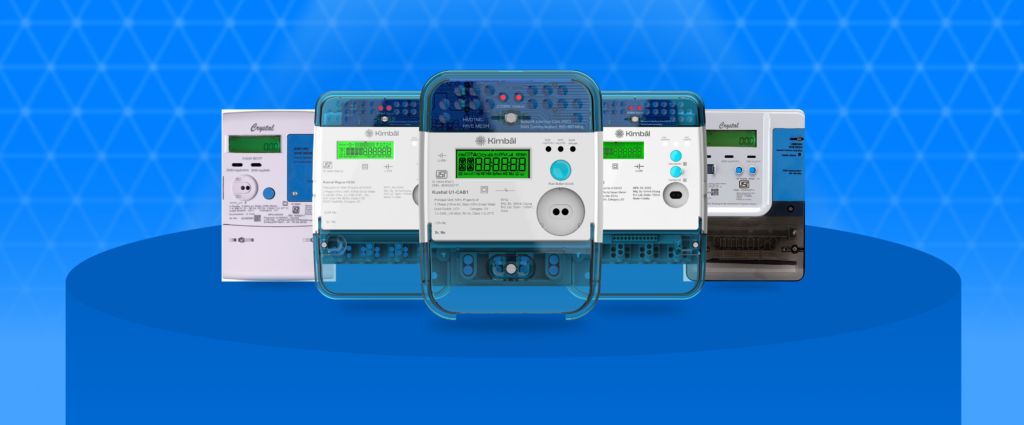
With Kimbal EI, Kimbal now supports a wide range of meter hardware, from cost-efficient 16-bit microcontrollers to powerful 32-bit and 64-bit processors. This unified software platform simplifies complexity, lowers the total cost of ownership, and speeds up the delivery of new features and services.
Built on a service-oriented architecture, Kimbal EI provides engineering teams with a flexible foundation for building and updating devices at scale. Teams can easily adapt meters for different utility requirements, roll out new capabilities over the air, and stay ahead of future needs. The result is a more intelligent, responsive, and future-ready AMI ecosystem.
Learn more: AMI 2.0, The next wave of Energy Intelligence, are we ready?
Kimbal’s global roadmap includes expansion into advanced energy markets such as Australia and the United States, where utilities increasingly rely on programmable meters capable of running utility and third-party applications, performing advanced diagnostics, and enabling real-time decision-making at the grid edge.
Kimbal EI is the digital backbone of Kimbal’s strategy to scale grid-edge intelligence worldwide, supporting use cases such as predictive maintenance, energy demand forecasting, and power-quality analytics. By leveraging Edge AI capabilities, Kimbal EI embeds intelligence directly into the device, supporting features such as NILM (Non-Intrusive Load Monitoring), DER integration, and behind-the-meter energy management.
“Through Kimbal Edge Intelligence platform, we aim to restore intelligence at the grid edge and enable proactive grid management through ecosystem collaboration. Analytics is fundamentally a lag indicator, explaining outcomes after events occur. Kimbal’s focus is on developing lead indicators that can identify emerging risks before they affect the grid” said Dave Lee, CTO of Kimbal.
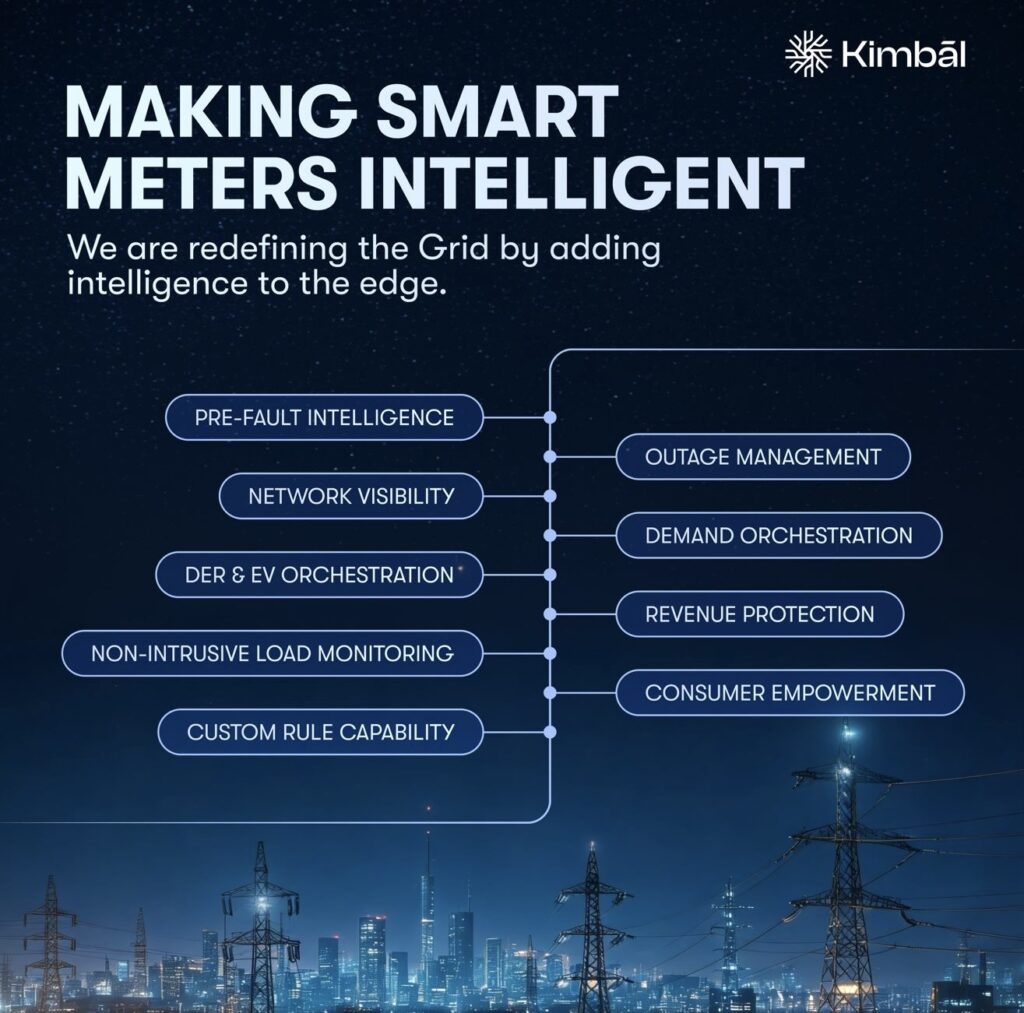
Kimbal EI brings AI and advanced analytics directly to smart meters, enabling faster decision-making, reduced communication costs, and greater operational flexibility. Let’s take a closer look at the key advantages that make this possible.
1. Portability & Ecosystem
Kimbal EI enables an application ecosystem where AI models can be downloaded and deployed on demand to meters already operating in the field. Models are not tied to any semiconductor vendor or instruction set; the virtual execution environment abstracts the hardware, allowing the same application to run consistently across different devices. As the platform evolves, AI models can be upgraded independently of hardware refresh cycles.
2. Learning at the Edge
Kimbal EI enables learning directly on the device, reducing dependence on constant cloud connectivity. Models can adapt to local operating conditions and continue delivering value even when backhaul communications are degraded or unavailable. This localized intelligence helps avoid the limitations of one-size-fits-all centralized models while improving resilience across diverse operating environments.
3. Fleet-Level Intelligence
A model that performs successfully in one location can be retrieved, analysed centrally, and deployed across thousands of devices where it delivers value. Embedded scoring mechanisms allow meters to identify anomalies locally and transmit only meaningful events to the cloud, reducing communication overhead while improving decision-making quality.
4. Customer-Specific Applications & Digital Twins
Utilities often have unique operational requirements. Kimbal EI supports secure, sandboxed applications that can be developed for customer-specific use cases without affecting core meter functionality. These applications can be tested and validated using digital twins before deployment, improving confidence and reducing operational risk during fleet-wide rollouts.
5. Target Edge AI Applications
Kimbal EI supports a broad range of advanced applications, including:
These applications extend the role of the smart meter from measurement and monitoring to active participation in grid operations.
Beyond its core Edge AI capabilities, Kimbal EI creates a foundation for a broader set of grid-intelligence applications that deliver value directly at the edge. By processing information locally, these capabilities can respond faster than traditional cloud-based approaches while reducing bandwidth requirements and improving operational resilience.
1. Pre-Fault Alerting & Predictive Maintenance
Edge AI models can identify early indicators of asset stress, including insulation degradation, loose connections, harmonic distortion, tree-branch contact, and other emerging fault conditions before they escalate into outages. Continuous waveform analysis enables utilities to shift from reactive maintenance to proactive asset management.
2. Intrinsic Fault Detection & Topology Awareness
Through edge-based event classification and localized intelligence, meters can autonomously identify voltage sags, swells, and interruptions while developing a deeper understanding of their position within the feeder network. By correlating disturbances across neighbouring devices, utilities gain greater visibility into fault locations and grid behaviour.
3. Self-Healing & Rule-Based Load Management
Kimbal EI supports autonomous, rule-based actions directly on the meter. During grid stress events, devices can execute pre-configured demand-response strategies, distinguish between different operating conditions, and respond in milliseconds without waiting for centralized commands. This capability represents a significant step toward more adaptive and self-healing grid operations.
4. DER, Storage & Grid Flexibility
As distributed energy resources such as rooftop solar, battery storage systems, and EV chargers become more prevalent, grid management becomes increasingly complex. Kimbal EI provides deeper visibility into reactive loading, fault-flow reversals, and behind-the-meter interactions that may not be visible through traditional monitoring systems, supporting more effective integration of distributed energy resources.
5. Optimized Communications & Flexible Service Delivery
Instead of transmitting large volumes of raw waveform data, Kimbal EI enables devices to communicate insights, anomaly flags, computed indices, and summarized events. This significantly reduces communication costs while creating opportunities for utilities to deploy specific analytics capabilities on demand through a flexible, application-based model.
6. Consumer Engagement & Prosumer Orchestration
Edge Intelligence also unlocks new opportunities for consumers and prosumers. Personalized energy insights, tariff optimization, automated demand-response participation, and intelligent management of rooftop solar and battery systems can all be executed locally with sub-second responsiveness. The result is a better consumer experience while helping utilities reduce peak demand and improve grid stability.
Learn more: The rise of the Prosumer Economy
As utilities worldwide move beyond traditional smart metering toward more intelligent, responsive, and software-defined energy systems, the role of the meter is evolving rapidly. What was once a device used primarily for measurement and billing is becoming a critical node in the digital energy ecosystem.
Kimbal Edge Intelligence represents a significant step in that evolution. By combining a flexible application ecosystem, Edge AI capabilities, fleet-level intelligence, and programmable software architecture, Kimbal is enabling utilities to unlock new value from infrastructure already deployed in the field.
From predictive maintenance and power-quality analytics to DER orchestration, consumer engagement, and autonomous grid operations, Kimbal EI creates a foundation for continuous innovation at the grid edge.
As the energy transition accelerates and power systems become increasingly distributed, intelligent devices will play a central role in helping utilities improve reliability, optimize operations, and create better experiences for consumers. Through Kimbal Edge Intelligence, Kimbal is helping build the software-defined foundation for the next generation of energy networks.
Learn more: Kimbal’s range of Smart Meters
What is Edge Intelligence in smart metering?
Edge Intelligence refers to processing data and running analytics directly on the smart meter instead of relying solely on cloud-based systems. This enables faster decision-making, lower communication costs, and improved reliability.
What are the key benefits of Kimbal EI for utilities?
Kimbal EI helps utilities deploy new services faster, reduce operational costs, improve grid visibility, support demand response programs, enable predictive maintenance, and accelerate AMI 2.0 adoption.
What is Kimbal Edge Intelligence (Kimbal EI)?
Kimbal Edge Intelligence is Kimbal’s software platform that transforms smart meters into programmable, app-ready devices capable of running advanced applications and Edge AI directly on the meter.
How is Kimbal EI different from traditional smart meter software?
Traditional smart meter software is often tightly coupled to specific hardware. Kimbal EI decouples software from hardware, enabling applications to run across multiple meter platforms and allowing new features to be deployed without replacing devices.
What types of Edge AI applications can run on Kimbal EI?
Kimbal EI enabled applications include predictive maintenance, power quality analytics, load forecasting, arc-fault detection, topology mapping, NILM (Non-Intrusive Load Monitoring), DER monitoring, and behind-the-meter energy management.
What is the role of AI in Kimbal EI?
AI models can be deployed directly on the meter to identify anomalies, predict faults, analyze consumption patterns, and generate actionable insights without requiring constant cloud connectivity.
How does Kimbal EI support AMI 2.0?
Kimbal EI enables advanced grid-edge intelligence, distributed decision-making, application-based functionality, and real-time responsiveness, all of which are key characteristics of next-generation AMI 2.0 networks.
How does Kimbal EI benefit consumers and prosumers?
Consumers gain access to personalized energy insights, demand-response participation, and energy optimization tools, while prosumers can better manage solar generation, battery storage, and EV charging.
Learn more: The rise of the Prosumer Economy
Published on 10 June 2026

Published on 8 June 2026
Published on 3 June 2026
Your email address will not be published. Required fields are marked *