
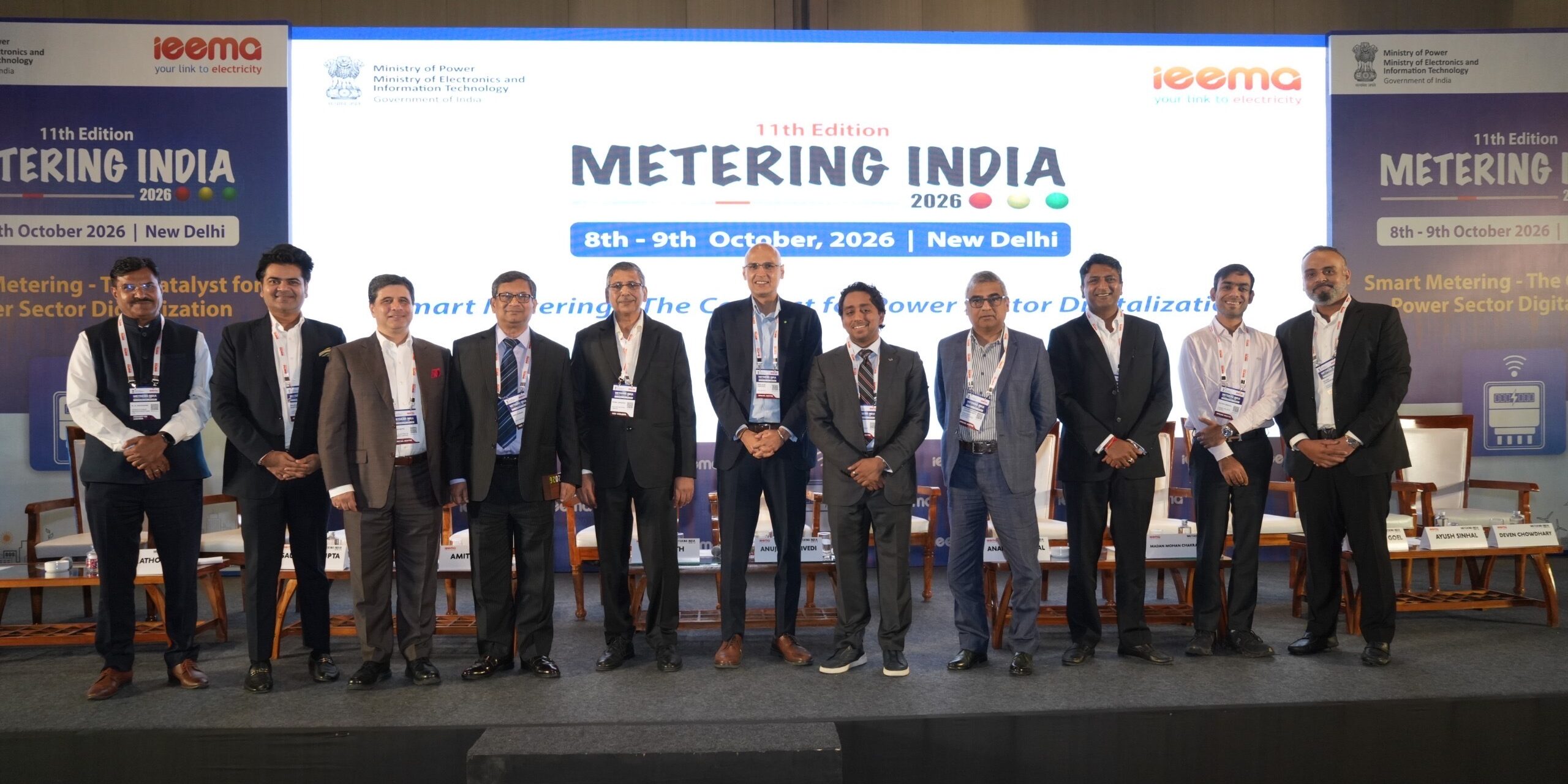
Kimbal Participates in Metering India 2026, Highlighting the Need to Strengthen India’s Smart Metering Ecosystem
Published on 13 October 2026




Solar power can help consumers generate their own power, reduce electricity bills, and even earn credits for excess electricity sent back to the grid. With initiatives like the PM Surya Ghar Muft Yojana making rooftop solar more accessible, more households across India are exploring solar as a cost-effective and sustainable energy solution. In this guide, we’ll explain how solar power works, the different types of solar systems, the benefits of going solar, how net metering helps maximize savings, and why prosumers are playing a growing role in India’s energy future.
Solar power is electricity generated from sunlight. Solar panels contain photovoltaic (PV) cells that absorb photons from sunlight and release electrons, creating direct current (DC) electricity. An inverter converts that DC electricity into alternating current (AC), the kind your fans, lights, air conditioners, and all other appliances run on.
Main components of a Solar Power system
How Solar Power works: a step-by-step guide
Key difference between traditionally generated electricity and solar energy
| Factor | Traditional Grid Electricity | Rooftop Solar Power |
| Source | Mostly coal and gas, non-renewable source | Sunlight, a renewable source |
| Monthly cost | Depends on the electricity rate in your state | Near zero once installed |
| Grid dependency | 100% dependent | Reduced significantly |
| Carbon emissions | High emission as it is dependent on a coal-heavy grid | Zero at point of use |
| Payback | You pay every month, forever | Investment recovers in 3-4 years |
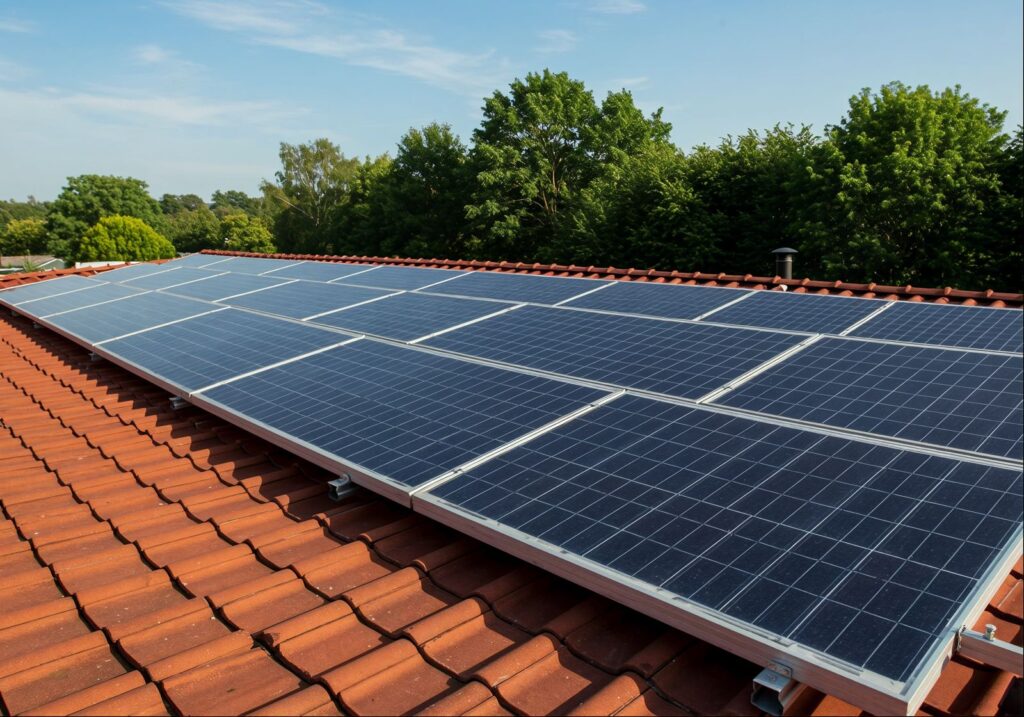
Installing a solar power system can help consumers save money, reduce dependence on grid electricity, and make better use of renewable energy. Here are some of the key benefits of adopting solar power.
Lower electricity bills
One of the biggest benefits of solar power is the potential to reduce consumer’s monthly electricity bills. Solar panels generate electricity from sunlight, allowing you to use less power from the grid during the day. The more electricity your solar system produces and consumes on-site, the lower your dependence on utility-supplied power.
In grid-connected systems, any excess electricity generated can be exported back to the grid through net metering, helping offset future electricity costs. Over time, this can lead to significant savings, especially for households and businesses with high daytime energy consumption.
Let’s look at some solar success stories from across India
Long-term cost savings
Solar power is a long-term investment that can help reduce electricity costs over the life of the system. While the initial installation cost varies depending on factors such as system size, location, and equipment, government initiatives like the PM Surya Ghar Muft Yojana have made rooftop solar more accessible for many households in India. Depending on electricity consumption patterns and local tariff structures, consumers may recover their investment over time through savings on their electricity bills. Most solar panels come with performance warranties of up to 25 years and can continue generating electricity beyond that period.
Cleaner and Sustainable Energy
In addition to helping reduce electricity costs, solar power enables consumers to generate electricity from a renewable energy source. By producing electricity on-site, households and businesses can reduce their reliance on conventionally generated grid power and contribute to a more diverse and sustainable energy mix. A typical 1 kW rooftop solar system can also help avoid approximately 1.2-1.5 tonnes of carbon dioxide emissions annually, making solar a practical way to reduce the environmental impact of electricity consumption.
As the adoption of rooftop solar continues to grow across India, supported by initiatives such as the PM Surya Ghar Muft Yojana, consumers have an opportunity to play a more active role in the country’s transition toward a cleaner and more resilient energy future.
Low Maintenance Requirements
Rooftop solar requires very little maintenance. Since solar panels have no moving parts, there is minimal wear and tear over time. In most cases, maintenance involves cleaning the panels periodically to remove dust, dirt, or bird droppings that may affect performance, along with occasional inspections of the wiring and inverter to ensure the system is operating efficiently. Solar installations do not require fuel, regular replacements of consumable components, or extensive upkeep.
Better Energy Independence
Solar power allows consumers to generate a portion of their own electricity, reducing their dependence on the grid. As a result, households and businesses can gain greater control over their energy consumption and are less exposed to fluctuations in electricity tariffs over time.
For consumers looking for additional reliability, solar systems can also be paired with battery storage. This enables excess solar energy to be stored and used when needed, providing backup power during outages and helping ensure a more consistent electricity supply.
The ideal size of a solar system depends on how much electricity you consume, the available roof space, and your energy goals. Consumers should review their monthly electricity bills to understand their average electricity consumption before choosing a system size. The table provides an estimate of the solar system size that may be suitable for your home based on your average monthly electricity consumption.
| Average monthly electricity consumption | Recommended solar system size | Indicative cost before subsidy* | Indicative cost after subsidy* |
| Up to 150 units/month | 1–2 kW | ₹60,000 – ₹1.2 lakh | ₹30,000 – ₹90,000 |
| 150–300 units/month | 2–3 kW | ₹1.2 lakh – ₹1.8 lakh | ₹60,000 – ₹1.3 lakh |
| 300–500 units/month | 3–5 kW | ₹1.8 lakh – ₹3.0 lakh | ₹1.0 lakh – ₹2.2 lakh |
| 500–800 units/month | 5–7 kW | ₹3.0 lakh – ₹4.2 lakh | ₹2.2 lakh – ₹3.4 lakh |
| Above 800 units/month | 7–10 kW+ | ₹4.2 lakh – ₹6.0 lakh+ | ₹3.4 lakh – ₹5.2 lakh+ |
*Note: Costs are indicative and may vary depending on the type of solar panels, inverter, installation requirements, location, and applicable subsidies. Consumers should consult authorized solar vendors and refer to the latest PM Surya Ghar Muft Yojana guidelines for current subsidy eligibility and benefits.
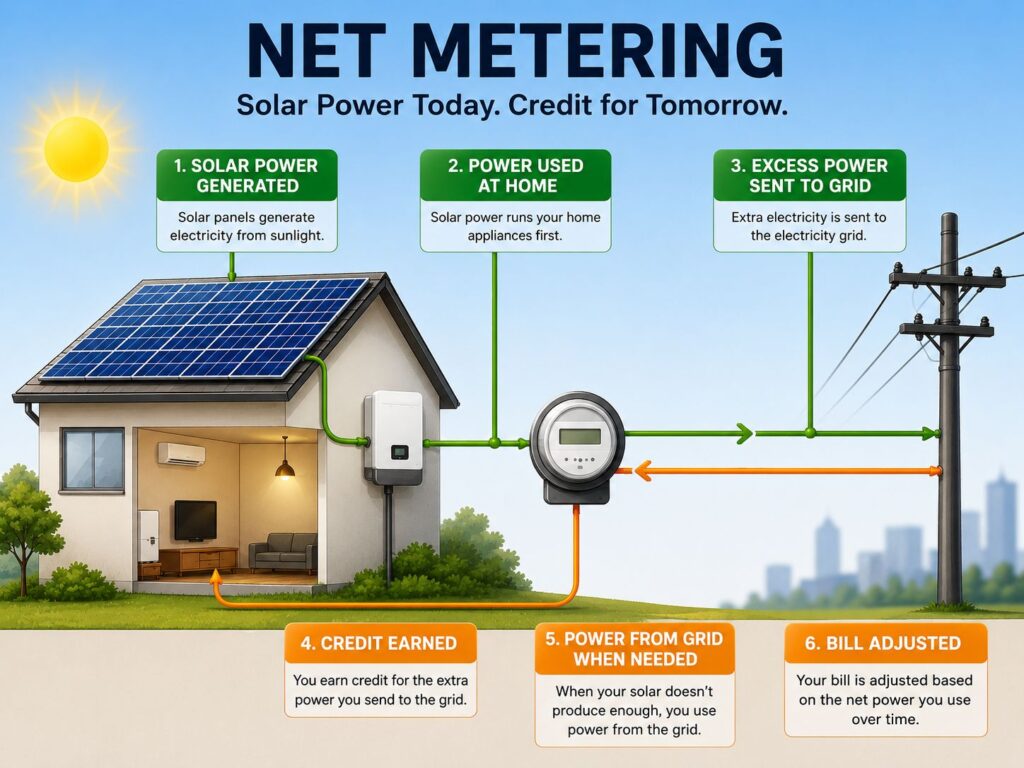
Net metering is the billing mechanism that makes rooftop solar financially worthwhile. Without it, surplus electricity your panels generate but your home does not immediately use would go to waste. With net metering, that surplus earns you real value. Think of it like a prepaid electricity wallet. When your panels produce more than you need, you load credits into the wallet. When you need power at night or on a cloudy day, you spend those credits. You only pay cash for any balance still owed at the end of the billing cycle.
How Net Metering Works, Step by Step
For example, your system generates 500 units in a month. Your home uses 350 units. You export 150 units to the grid. At billing, you owe zero on unit charges. The 150-unit credit carries forward.
Benefits of Net Metering
Net Metering vs Gross Metering
| Factor | Net Metering | Gross Metering |
| What gets exported | Only surplus electricity | All generated electricity |
| Credit rate | At or near retail tariff | At a lower feed-in tariff |
| Home usage | Consumed directly from solar | Purchased back from grid at full tariff |
| Best for | Residential consumers | Large commercial generators |
| Financial benefit | Higher for most homes | Lower for most homes |
What India’s Net Metering Rules Say in 2025
The government permits net metering for solar systems up to 500 kW or the sanctioned load of the connection, whichever is lower. Both residential and commercial installations qualify. Key highlights from India’s top-performing states:
To find your state’s net metering rules and empanelled installers, visit: mnre.gov.in and pmsuryaghar.gov.in
A conventional electricity meter records only how much electricity you import from the grid. A smart meter does far more. It records electricity flows in both directions, tracks your solar generation and home consumption in near real time, communicates data automatically to your DISCOM, and provides the billing foundation that makes net metering work. Without a smart or net meter, your DISCOM cannot track what you export, and net metering credits cannot be calculated.
How Smart Meters Support Solar Energy Management
India’s Smart Meter Rollout
The Ministry of Power’s Revamped Distribution Sector Scheme (RDSS) has sanctioned Rs 2.83 lakh crore for distribution infrastructure upgrades, including nationwide smart meter deployment. The government has mandated interoperability across all smart meter manufacturers so no household or DISCOM gets locked into one vendor. For solar users, this rollout means better billing transparency and real-time energy insights become standard features, not exceptions. The MNRE is also rolling out a mobile-based net metering tracker for solar households, expected by 2026.
Learn more: How to Read Your Smart Meter Display: 2026 Guide for electricity consumers in India
Smart Meter vs Traditional Meter for a Solar-Powered Home
For a home with rooftop solar, a smart meter offers significant advantages over a traditional meter. It accurately tracks both electricity consumption and solar exports, supports automated net metering, and gives homeowners greater visibility into their energy usage. This makes it easier to maximize solar savings and participate in a smarter, more connected electricity grid.
| Feature | Smart Meter | Traditional Meter |
| Solar Energy Tracking | Automatically records both electricity imported from and exported to the grid. | Primarily records electricity consumption; limited support for two-way energy measurement. |
| Net Metering | Enables automated net metering and accurate calculation of solar export credits. | Requires separate arrangements or manual processes for net metering in many cases. |
| Real-Time Monitoring | Provides near real-time data on electricity usage and solar generation. | Does not provide real-time consumption or generation insights. |
| Billing Accuracy | Automatically calculates energy imports, exports, and net payable units. | Relies on periodic meter readings and may not support detailed energy accounting. |
| Consumer Visibility | Allows households to monitor usage, generation, and balance through digital platforms. | Limited visibility until the monthly bill arrives. |
| Energy Management | Helps homeowners optimize appliance usage based on solar generation patterns. | Offers little information to support energy-saving decisions. |
| Remote Reading | Meter readings can be collected remotely without a site visit. | Requires manual meter reading by utility personnel. |
| Future Readiness | Supports smart grids, dynamic tariffs, and advanced solar programs. | Designed primarily for one-way electricity consumption measurement. |
Learn more: Smart Meter vs Traditional Meter: Key Differences Explained (2026 Guide)
Smart Meter vs Net Meter: What’s the Difference?
Historically, rooftop solar systems required a dedicated net meter to measure electricity imports and exports for net metering. Today, many utilities are deploying bi-directional smart meters that perform the functions of both a smart meter and a net meter in a single device. These meters can measure electricity consumed from the grid, electricity exported to the grid, and automatically calculate net energy for billing.
| Feature | Smart Meter | Net Meter |
| Primary Purpose | Measures electricity consumption and, in many cases, electricity exported to the grid. | Specifically measures the net difference between electricity imported from and exported to the grid. |
| Data Availability | Provides near real-time consumption and generation data. | Typically records cumulative import and export readings for billing. |
| Communication | Can transmit meter readings automatically to the utility. | Usually does not support advanced communication features. |
| Billing Support | Enables automated billing, usage tracking, and smart energy management. | Supports net metering calculations and solar export credits. |
| Role in Solar Systems | Helps monitor solar generation, consumption, and grid interaction. | Calculates how much electricity you consumed from the grid versus how much you supplied back. |
| Smart Grid Compatibility | Designed for future-ready smart grids and digital energy management. | Primarily designed for net metering and billing purposes. |
Learn more: Smart Metering Companies in India: A Complete Guide for Electricity Consumers
Does a prosumer need both net meter and smart meter for rooftop solar?
In many modern solar installations, a single bi-directional smart meter is sufficient because it combines smart metering and net metering capabilities. However, the exact requirement depends on your local utility’s regulations and metering infrastructure. Some utilities may still use separate net meters, while others have transitioned entirely to smart meters that support net metering.
A prosumer is someone who both produces and consumes energy. In electricity terms, you become a prosumer the moment your rooftop solar panels send surplus power to the grid. Up till now, your relationship with electricity ran in one direction: the power company produced it, and you paid for it. Solar reverses part of that equation. India’s Solar Export Policy 2025 formally recognises every grid-connected solar household as a potential prosumer, and the government’s goal is to create 2 crore solar prosumers by 2030. Households earning through net metering can bring in Rs 12,000 to Rs 25,000 per year from surplus electricity, depending on system size and state tariff.
Why the Prosumer Model Matters
Prosumers and Smart Grids
As India scales its smart grid infrastructure under the RDSS, prosumers become central players. A smart grid can manage real-time two-way power flows, balance supply and demand automatically, and support dynamic pricing. Prosumers feeding solar into this grid are essential participants in India’s decentralised energy future.
Learn more: Smart Grid vs Traditional Grid: Key Differences, Benefits & the Future of Electricity
Rooftop Solar for Apartments
If you live in an apartment and wonder whether any of this applies to you, it does. Group Net Metering allows a housing society to install one shared system on the common terrace and distribute credits across all flats, including renters. Karnataka already allows this and other states are expanding similar schemes. Many societies start by installing solar for common areas (lifts, lights, pumps) before scaling to individual units.
Launched in February 2024 with a total outlay of ₹75,000 crore, this is India’s flagship rooftop solar scheme. Its target is to install solar panels in one crore households by 2027, providing up to 300 units of free electricity per month.
As of December 2025, 23.9 lakh households have installed rooftop solar under the scheme. Around 13.5 crore rupees have been released as subsidy via Direct Benefit Transfer (DBT)
As solar policies and incentives are updated periodically, it is always advisable to verify the latest benefits available in your state before making an investment decision.
India’s Broader Renewable Energy Investment
India’s solar sector continues to grow rapidly, supported by strong policy initiatives and increasing investment. In the Union Budget 2026–27, the Ministry of New and Renewable Energy (MNRE) received an allocation of ₹33,000 crore to support the country’s clean energy transition.
India has also become the world’s third-largest solar power producer. As of June 2025, the country’s non-fossil fuel installed capacity stood at 242.8 GW, achieving the target of 50% installed capacity from non-fossil fuel sources five years ahead of schedule. Solar energy accounts for a significant share of this achievement.
Adding its latest 50 GW of solar capacity in just 14 months, India has crossed the landmark 150 GW milestone, as per the recent reports by Ministry of New and Renewable Energy. This rapid growth has propelled India to become the world’s second-largest market for annual solar capacity additions in 2025, surpassing the USA.
As rooftop solar adoption grows, so do the misconceptions surrounding it. Let’s bust some common myths about solar power and its real-world usage.
Myth: Solar panels only work in strong sunlight
Fact: Solar panels generate electricity from daylight, not just direct sunlight. While energy output may decrease during cloudy weather, solar panels continue to produce power throughout the day. With approximately 250–300 sunny days annually, India offers excellent conditions for rooftop solar generation.
Myth: Solar power systems require constant maintenance
Fact: Modern solar power systems require very little maintenance. Most homeowners only need to clean the panels periodically and schedule occasional inverter inspections. Solar panels are designed for long-term performance and typically come with warranties of up to 25 years.
Myth: Solar power is too expensive for the average household
Fact: Government incentives have made rooftop solar more affordable than ever. Under the PM Surya Ghar Yojana, eligible households can receive subsidies of up to ₹78,000 for rooftop solar installations. In many cases, the savings on electricity bills allow the system to recover its cost within three to four years.
Myth: Solar power is only suitable for large homes and commercial buildings
Fact: Rooftop solar systems are available in a range of sizes and can be installed on small residential properties. Systems starting from 1 kW are suitable for households with modest electricity consumption.
Myth: Apartment residents cannot benefit from solar energy
Fact: Apartment residents can also benefit from solar power through shared rooftop installations. Group Net Metering enables housing societies to distribute solar generation credits among multiple flats, allowing both homeowners and tenants to reduce their electricity costs.
India’s Net Zero 2070 Goal and the Role of Solar
At COP26 in 2021, India committed to net-zero carbon emissions by 2070 and a target of 500 GW of non-fossil fuel capacity by 2030. Solar is the primary vehicle for both. India has already crossed 242.8 GW of non-fossil fuel capacity as of June 2025, 50% of total installed capacity, meeting its 2030 clean energy share target five years early.
The Rise of Prosumers, Smart Grids, and Digital Energy Management
India’s solar future is moving towards a smart and digitally connected grid. In this system, millions of prosumer households will both consume and generate electricity, feeding surplus solar power back into the grid. Smart meters will enable real-time, two-way billing, automatically tracking both electricity consumption and solar power exports.
Virtual power plants will combine thousands of rooftop solar systems, allowing them to operate as a single grid-scale energy asset. Dynamic electricity pricing will reward solar users who export power during periods of high demand. The Ministry of New and Renewable Energy (MNRE) is also expected to introduce a mobile-based net metering tracker by 2026. This tool will allow solar households to monitor their energy generation, exports, and overall contribution to the grid in real time.
What is solar power and how does it work?
Solar power is electricity generated from sunlight via photovoltaic (PV) cells in solar panels. PV cells absorb photons and release electrons, producing direct current (DC) electricity. An inverter converts this to alternating current (AC) so your home’s appliances can use it.
Can solar power really reduce my electricity bill?
Yes. Rooftop solar can significantly reduce your monthly electricity bill by generating power for your home during daylight hours. Any surplus electricity produced can be exported to the grid through net metering, earning credits that offset future electricity consumption. Depending on system size, energy usage, and local net metering policies, households can reduce their electricity bills by 70–90% or more over the lifetime of the system.
What is net metering and how does it work?
Net metering is a billing arrangement where a DISCOM credits household for every unit of surplus solar electricity export to the grid. At billing time, households pay only for net units consumed, units imported minus units exported. If exports exceed imports, the credit carries forward to next month.
What happens to unused solar electricity?
With net metering, surplus electricity is exported to the grid and earns billing credits. With battery storage, households can store it for use at night or during power cuts. Most urban Indian homes use an on-grid system with net metering, which is the most cost-effective option.
What is the difference between net metering and gross metering?
With net metering, only the surplus (unused) electricity goes to the grid, credited at near-retail rate. With gross metering, all generated electricity goes to the grid first, at a lower feed-in tariff, and households can buy back whatever they need. Net metering is more financially beneficial for most residential users.
What is a prosumer and how do I become one?
A prosumer is a consumer who also produces electricity. In the context of solar energy, a household with a rooftop solar system can generate its own power for daily use and export any surplus electricity to the grid. To become a prosumer, you need to install a rooftop solar system and enroll in your utility’s net metering program. This allows you to use self-generated solar power, reduce your electricity bills, and earn credits for excess energy supplied to the grid.
Learn more: The Rise of the Prosumer Economy Globally
What role do smart meters play in solar energy?
Smart meters are essential for solar users. They record electricity flows in both directions, provide real-time generation and consumption data, and automate net metering billing. Without a smart or bidirectional net meter, the DISCOM cannot calculate your credits accurately.
Learn more: How to Recharge Your Smart Meter Online and Offline in India (2026 Guide)
Is rooftop solar suitable for apartments?
Yes. Apartment residents can benefit from rooftop solar through shared solar installations managed by housing societies or residential complexes. Under Group Net Metering and similar frameworks available in several states, the electricity generated from a common rooftop solar system can be distributed among multiple flats, helping residents reduce their electricity bills. This enables apartment dwellers to participate in the clean energy transition even if they do not have access to a private rooftop.
How long do solar panels last, and do they need maintenance?
Solar panels are designed for long-term performance and typically last 25 years or more. Most manufacturers provide performance warranties of up to 25 years, ensuring that the panels continue to generate electricity efficiently over their lifespan. Maintenance requirements are minimal and usually involve periodic cleaning to remove dust and debris, along with occasional inspections of the inverter and electrical connections to ensure optimal performance.
What government support is available for rooftop solar in India?
The PM Surya Ghar Muft Bijli Yojana offers central government subsidies of Rs 30,000 per kW for 1 to 2 kW systems and a cap of Rs 78,000 for 3 kW and above, for residential installations. Several states including Gujarat, Delhi, Rajasthan, and Maharashtra offer additional subsidies. For more information visit pmsuryaghar.gov.in
How soon will I recover my solar investment?
Most residential rooftop solar systems in India reach payback in 3 to 4 years after accounting for subsidies and monthly savings. After payback, the system keeps generating free electricity for 20 or more years.
How does rooftop solar connect to India’s Net Zero 2070 goal?
India has committed to net-zero emissions by 2070 and 500 GW of non-fossil fuel capacity by 2030. India already crossed 242.8 GW of non-fossil capacity as of June 2025, meeting the 50 percent clean energy share target five years early. Every rooftop solar installation contributes directly to this milestone by replacing coal-based electricity.
Do I need both a smart meter and a net meter for rooftop solar?
Not necessarily. Many modern rooftop solar installations use a single bi-directional smart meter that can measure both electricity consumed from the grid and surplus solar power exported back to it. This allows the meter to perform the functions of both a smart meter and a net meter, enabling accurate net metering and billing. However, metering requirements vary by utility and state regulations, so some areas may still require a separate net meter for solar connections. In Simple Terms:
Published on 13 October 2026

Published on 7 October 2026

Published on 6 October 2026
Your email address will not be published. Required fields are marked *