
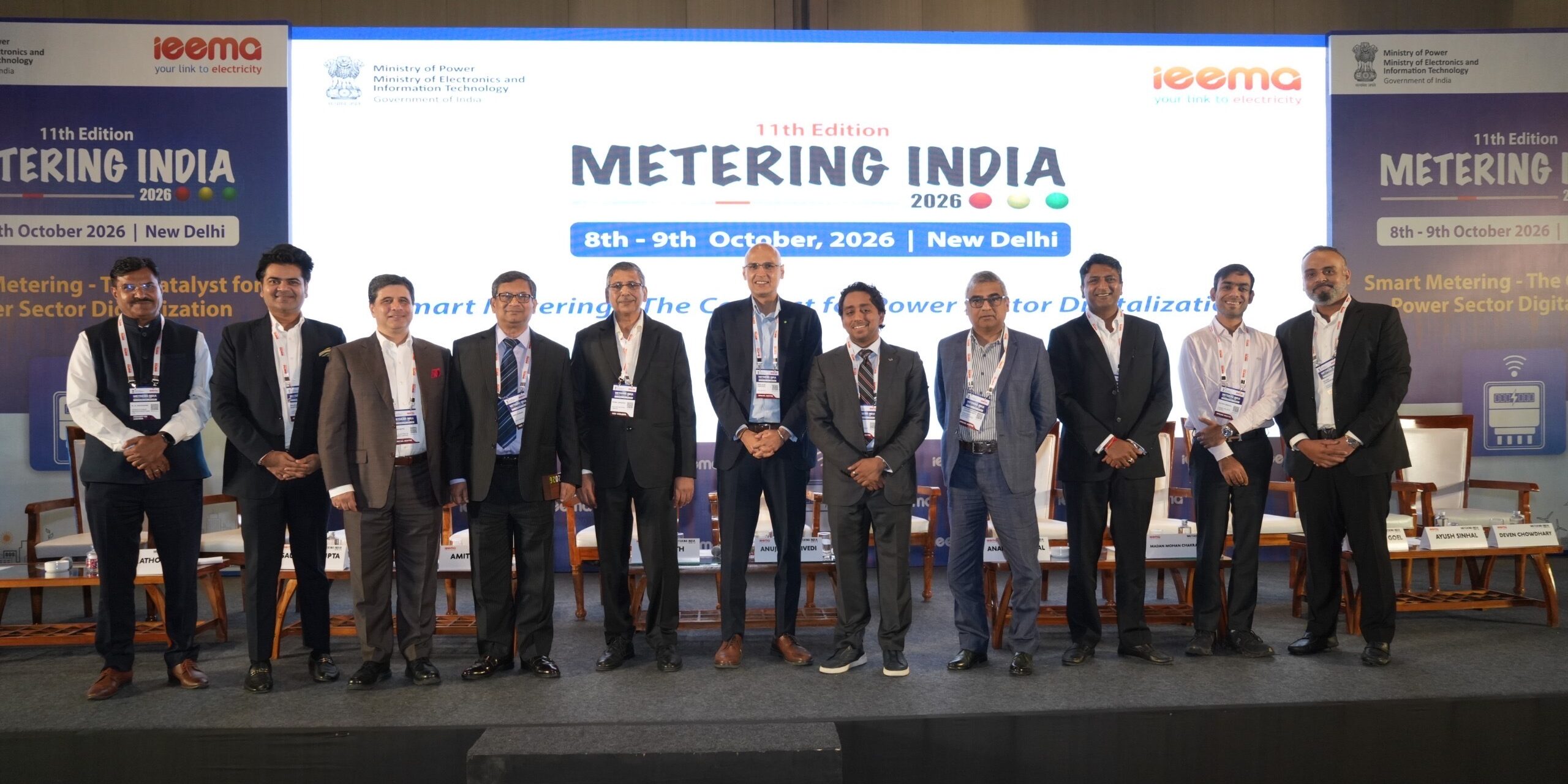
Kimbal Participates in Metering India 2026, Highlighting the Need to Strengthen India’s Smart Metering Ecosystem
Published on 13 October 2026




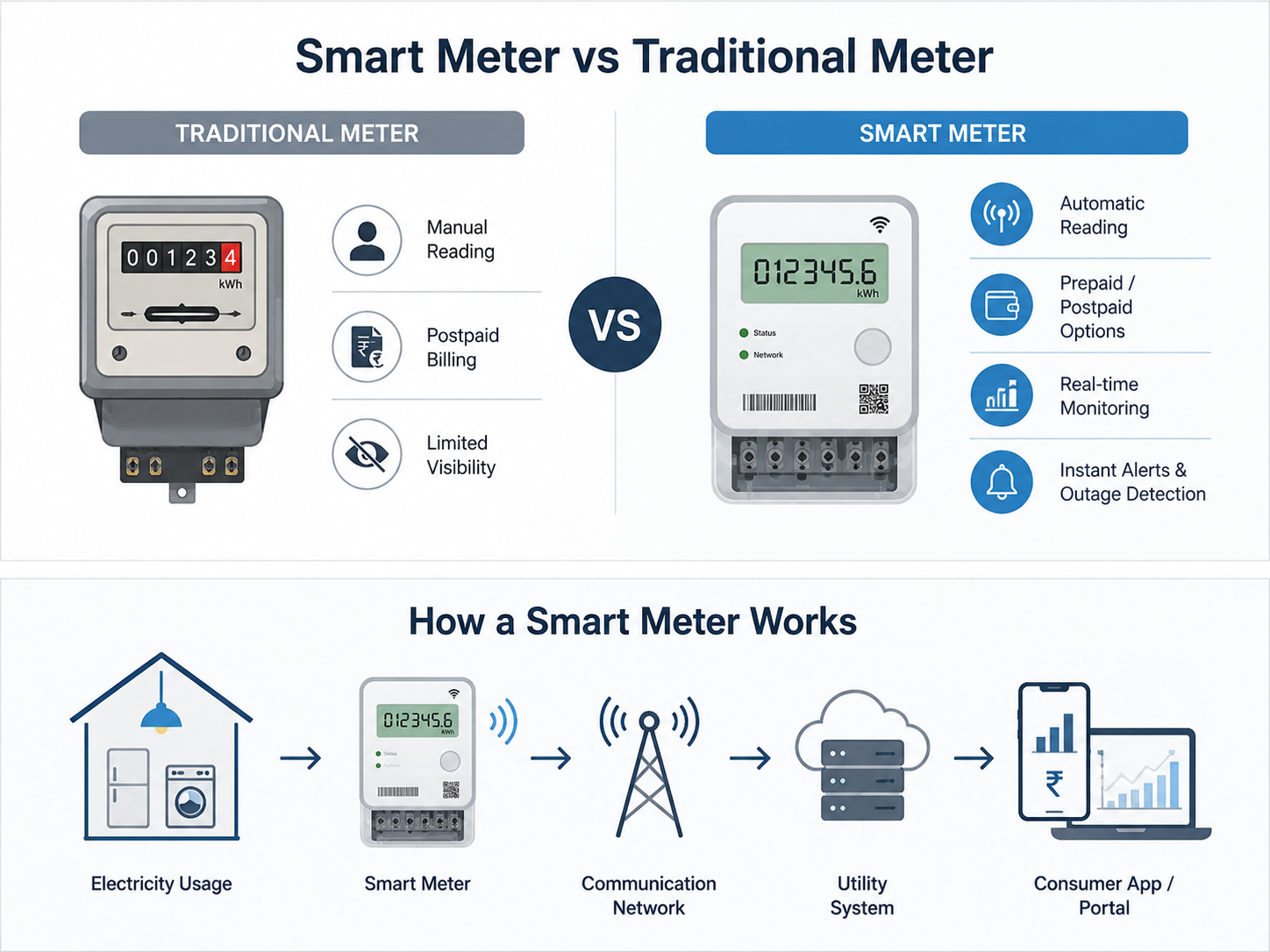
The biggest difference between a smart meter and a traditional meter is how they collect and share electricity consumption data. A traditional meter records electricity usage and requires a meter reader to visit the premises and collect readings. A smart meter records electricity usage and automatically sends consumption data to the electricity utility through a secure communication network.
While both meters measure electricity consumption, smart meters offer several additional capabilities. These include real-time usage monitoring, remote meter reading, prepaid recharge options, faster outage detection, improved billing accuracy, and better integration with modern electricity networks. For consumers, this means greater visibility into electricity consumption and easier access to digital services. For utilities, it means more efficient operations and fewer manual processes.
As India continues its smart meter rollout under the Revamped Distribution Sector Scheme (RDSS), understanding the difference between a smart meter and a traditional meter has become increasingly important for households and businesses alike.
Learn more: Smart Metering Companies in India: A Complete Guide for Electricity Consumers
A traditional electricity meter measures the amount of electricity consumed by a household, shop, office, or industrial facility. Its primary job is simple: record electricity usage so the utility can calculate the bill. For decades, traditional meters have formed the backbone of electricity billing across India.
How Does a Traditional Meter Work?
Every time you switch on a fan, air conditioner, refrigerator, or any other electrical appliance, the meter records the electricity consumed. The total electricity usage appears in units, also known as kilowatt-hours (kWh).
At regular intervals, a meter reader visits the premises, records the reading, and sends the information to the utility for bill generation.
Types of Traditional Meters
1. Electromechanical Meters: Older meters use a rotating metal disc. The faster the disc spins, the higher the electricity consumption.
2. Electronic Digital Meters: Most modern installations use digital meters that display readings electronically. While they offer better accuracy than electromechanical meters, they still require manual reading in many cases.
The process works, but it depends heavily on manual intervention.
Limitations of Traditional Meters
Traditional meters perform a basic but important function. However, they have several limitations:
Think of a traditional meter as a notebook that records information. The information exists, but nobody can access it until someone physically checks the notebook.
Learn more: 1 Unit Electricity Cost in India (2026): State-Wise Tariff & Bill Calculation Guide
A smart meter is a digital electricity meter that measures consumption and automatically communicates usage data to the electricity utility. Unlike traditional meters, smart meters do not depend on manual reading. They form an important part of India’s modern electricity infrastructure and play a key role in smart grid development.
How Does a Smart Meter Work?
A smart meter performs three functions simultaneously:
This communication happens through a secure network that forms part of an Advanced Metering Infrastructure (AMI). The utility can access meter data remotely, reducing the need for physical visits.
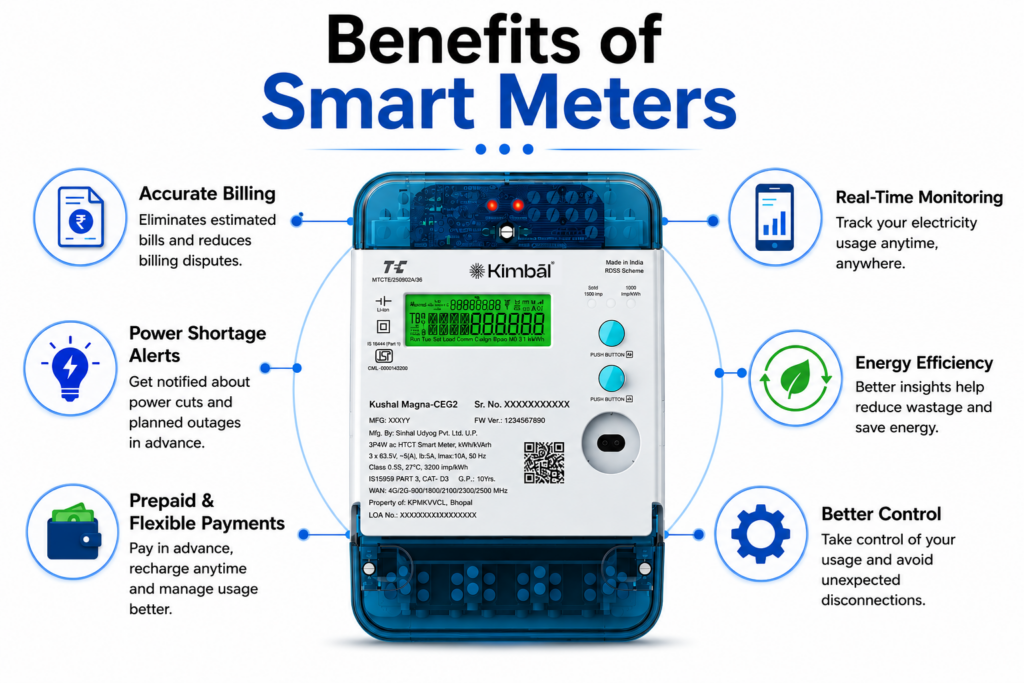
This automated flow reduces delays and improves visibility for both utilities and consumers.
Learn more: How to Read Your Smart Meter Display: 2026 Guide for electricity consumers in India
Key Features of Smart Meters
Think of a smart meter like a smartphone. A traditional meter is similar to a feature phone that performs one task. A smart meter not only records information but also communicates it automatically, enabling a range of digital services.
Learn more: Smart Grid vs Traditional Grid: Key Differences, Benefits & the Future of Electricity
| Parameter | Smart Meter | Traditional Meter |
| Meter reading | Automatic | Manual |
| Data transmission | Automatic | Not available |
| Reat-time monitoring | Available | Not available |
| Billing accuracy | High | Depends on manual processes |
| Human intervention | Minimal | Significant |
| Consumption visibility | High | Limited |
| Outage detection | Automatic | Consumer must report |
| Theft detection | Advanced capabilities | Limited |
| Online recharge | Available in prepaid systems | Not available |
| Mobile app integration | Supported | Usually not supported |
| Usage alerts | Available | Not available |
| Peak demand tracking | Available | Limited |
| Remote connection and disconnection | Supported | Not supported |
| Operational efficiency | High | Moderate |
| Billing cycle flexibility | High | Limited |
| Solar compatibility | Better suited | Basic support |
| Smart grid integration | Designed for it | Limited |
| Data availability | Near real-time | Periodic |
| Maintenance visits | Reduced | Frequent |
| Consumer control | Greater | Limited |
| Future readiness | High | Low |
One of the most common questions consumers ask relates to billing. Many people want to know whether they need to recharge a smart meter, how bills are generated, and whether electricity can disconnect automatically.
How billing works in a traditional meter:
This model is commonly known as postpaid billing. You consume electricity first and pay later.
How Billing Works in a Smart Meter:
Smart meters can support both prepaid and postpaid billing models.
This model gives consumers greater control over spending and consumption habits.
Does smart meter require recharge?
A traditional meter does not require recharge. A prepaid smart meter requires consumers to add balance periodically, similar to recharging a prepaid mobile connection.
Not all smart meters are prepaid. Utilities can configure smart meters for either prepaid or postpaid operation.
Can Electricity Disconnect Automatically?
In prepaid systems, electricity supply may disconnect if the available balance reaches zero and no emergency credit remains.
Utilities usually provide notifications before this happens.
Traditional meters generally do not disconnect automatically due to balance exhaustion because consumers receive bills after consumption.
Which Option Provides Better Bill Visibility?
Smart meters offer better visibility. Consumers can track consumption patterns, identify high-usage appliances, and monitor spending more effectively. Traditional meters only provide limited information until the next bill arrives.
What is the difference between a smart meter and a traditional meter?
A traditional meter records electricity consumption and requires manual reading, while a smart meter automatically records and transmits usage data to the electricity utility. Smart meters also support features such as real-time consumption monitoring, remote meter reading, prepaid billing, and outage detection.
Is a smart meter more accurate than a traditional meter?
Both smart meters and traditional meters must meet regulatory accuracy standards. However, smart meters reduce the chances of human error because they automatically transmit readings to the utility instead of relying on manual meter reading.
Can a smart meter help reduce my electricity bill?
A smart meter does not directly reduce electricity consumption. However, it helps consumers monitor their usage more closely, identify high-consumption appliances, and make informed decisions that can lower electricity costs.
Do smart meters require internet from consumers?
No. Smart meters use dedicated communication networks established by electricity utilities. Consumers do not need a home Wi-Fi connection or personal internet service for the meter to function.
Can I recharge a smart meter online?
Yes. If your utility operates a prepaid smart metering system, you can usually recharge your smart meter through official utility portals, mobile applications, payment platforms, or authorized recharge centres.
Learn more: How to Recharge Your Smart Meter Online and Offline in India (2026 Guide)
Are all smart meters prepaid?
No. Smart meters can operate in both prepaid and postpaid modes. The billing model depends on the electricity utility’s implementation and policies.
Can electricity disconnect automatically with a smart meter?
In prepaid smart meter systems, electricity supply may disconnect when the available balance reaches zero. Utilities typically provide alerts and notifications before this happens. In postpaid systems, disconnection follows the utility’s standard procedures.
Why is my electricity utility replacing my traditional meter?
Utilities are replacing traditional meters to improve billing accuracy, reduce manual processes, detect outages faster, minimize energy losses, and provide consumers with better access to consumption data.
Learn more: Smart Meters in India Explained: Benefits, Prepaid Model, and RDSS Guide (2026)
Can smart meters work during power outages?
Yes. Smart meters can record outage events and help utilities identify affected areas more quickly. However, the meter itself cannot supply electricity during a power cut.
Do smart meters consume electricity?
Yes, smart meters use some amount of electricity to perform functions such as measurement and communication. However, this consumption is borne by the utility and is not billed to the consumers. As a result, a smart meter does not increase your electricity bill.
Can smart meters detect electricity theft?
Smart meters include advanced monitoring capabilities that help utilities identify unusual consumption patterns, meter tampering, and potential electricity theft more effectively than traditional meters.
Are smart meters safe to use?
Yes. Utilities deploy smart meters according to national standards and regulatory guidelines. Smart meters undergo testing and certification before installation to ensure safe and reliable operation.
Which is better: a smart meter or a traditional meter?
For most consumers, a smart meter offers greater visibility, convenience, and control over electricity consumption. However, both smart meters and traditional meters accurately measure electricity usage. The right choice depends on the utility infrastructure available in your area and your consumption needs.
Can smart meters be used with rooftop solar systems?
Yes. Smart meters can support solar installations, net metering programs, and two-way energy measurement. This makes them well suited for households that generate electricity through rooftop solar systems.
Are smart meters mandatory in India?
Smart meter deployment is expanding across India under government-led initiatives such as the Revamped Distribution Sector Scheme (RDSS). However, implementation timelines vary by state and electricity utility.
How can I check my smart meter reading?
Depending on your utility, you can view smart meter readings through the meter display, utility mobile applications, web portals, consumer dashboards, or SMS-based services.
Learn more: What is Smart Meter Reading? How It Works, Benefits & AMI Explained (2026 Guide)
Do smart meters support both residential and commercial consumers?
Yes, utilities install smart meters for residential, commercial, industrial, and institutional consumers to improve monitoring, billing, and energy management.
How often does a smart meter send readings?
The frequency varies by utility and system configuration. Some smart meters transmit data multiple times a day, while others may communicate at scheduled intervals determined by the utility.
Will a smart meter change the way I receive my electricity bill?
The billing format may remain largely the same, but smart meters provide more detailed consumption information and can support additional services such as prepaid billing, digital payment options, and usage tracking.
Learn more: How to Read Your Smart Meter Display: 2026 Guide for electricity consumers in India
Published on 13 October 2026

Published on 7 October 2026

Published on 6 October 2026
Your email address will not be published. Required fields are marked *