
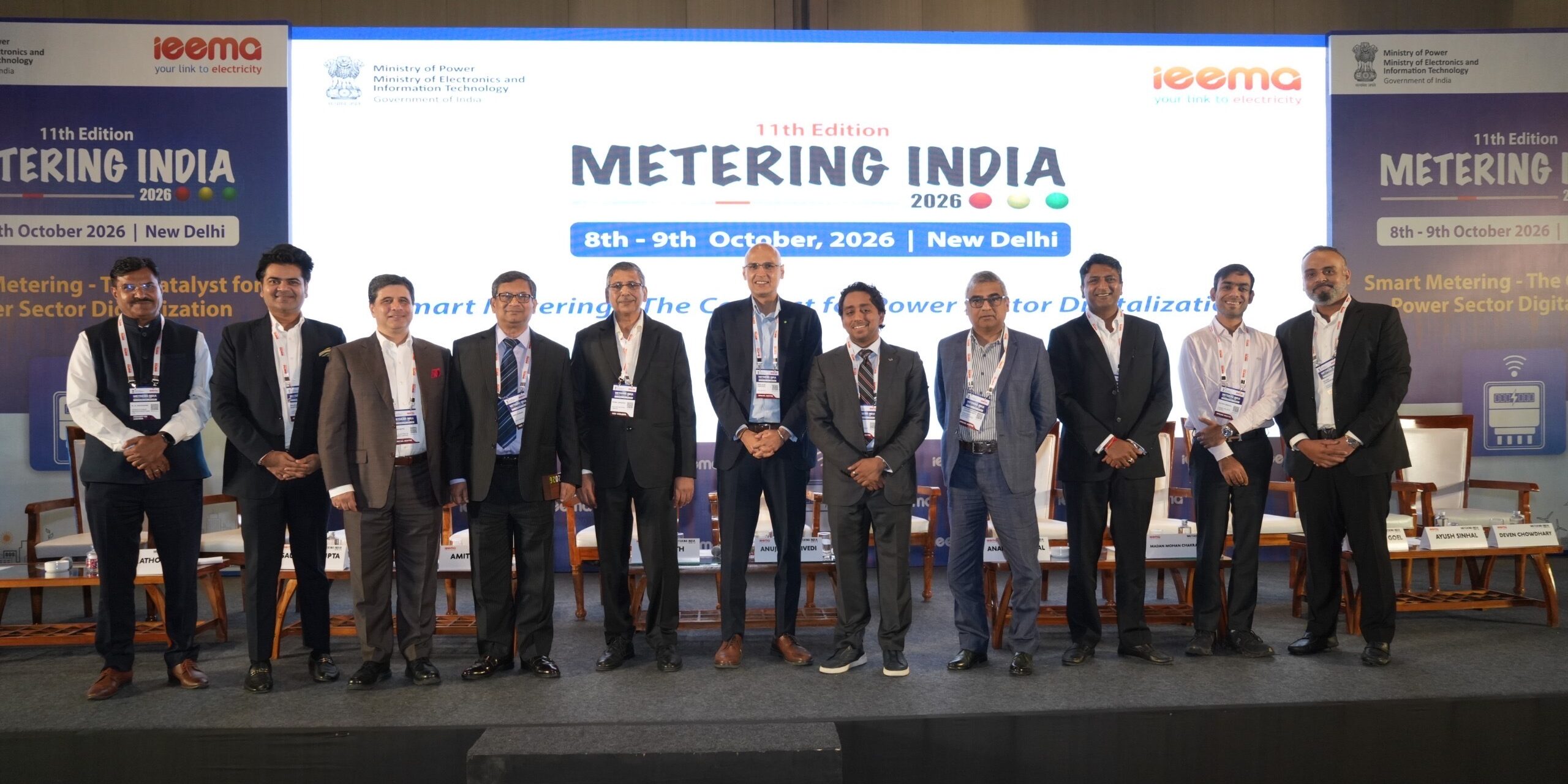
Kimbal Participates in Metering India 2026, Highlighting the Need to Strengthen India’s Smart Metering Ecosystem
Published on 13 October 2026




In this guide, you'll learn whether an electrical energy meter and an electricity meter are different, what an electricity meter measures, and how it records your electricity consumption in kilowatt-hours (kWh), also known as electricity units. You'll also understand the different types of electricity meters used across India, why the Government of India is replacing conventional meters with smart meters under the RDSS programme, how meter readings are converted into your monthly electricity bill, and the answers to the most frequently asked questions about electricity meters.
An electrical energy meter and an electricity meter are technically the same device. Both measure the amount of electrical energy you consume, in kilowatt-hours (kWh), which forms the basis of your electricity bill. The difference is mainly in terminology:
Every time you switch on a light, run a fan, charge your phone, or operate an appliance, your meter records the electrical energy you use over time. Electricity distribution companies measure this consumption in kilowatt-hours (kWh), commonly called electricity units, and use this value to calculate your monthly electricity bill.
Engineers call it an electrical energy meter, because that name says exactly what it does: it measures electrical energy. Your electricity provider calls the same device an electricity meter, because that’s the simpler word most people already know and use when talking about their bill. Neither name is more “correct.” They’re just two ways of describing the same device, one built for precision, one built for everyday conversation.
Electricity metering technology has also evolved significantly over the years. Electronic digital meters have largely replaced traditional electromechanical meters, and today, India is rapidly deploying smart meters under the Government of India’s Revamped Distribution Sector Scheme (RDSS). These advanced meters enable features such as automatic meter reading, near real-time consumption monitoring, prepaid billing, remote connection and disconnection, and improved billing transparency for both consumers and electricity distribution companies.
Whether your home has an older digital meter or one of the latest smart meters, its primary purpose remains the same: to accurately measure the electrical energy you consume, so utilities can monitor your usage and bill you correctly.
Every home, office, factory, and commercial building has an electrical energy meter, keeping count of exactly how much electricity gets used. Electricity distribution company (DISCOMs) installs it to record your usage accurately, so it can prepare your bill.
The meter measures energy in kilowatt-hours (kWh). Every unit your electricity bill shows equals one kilowatt-hour. Think of it like the odometer in a car, it records the total distance you’ve travelled. In the same way, an electrical energy meter records the total electricity you’ve used over time.
Electricity meter is simply the everyday name for the electrical energy meter we just covered. People use several names for the same device, often without realising it:
All these generally refer to the same device that sits outside your home or building. One name worth knowing separately is power meter. Technically, a power meter measures electrical power at a given moment, while an electricity meter measures the energy consumed over time. The two sound similar, but they are not measuring the same thing.
| Feature | Electrical Energy Meter | Electricity Meter |
| Meaning | Technical term | Common consumer term |
| Measures | Electrical energy | Electrical energy |
| Unit measured | kWh | kWh |
| Used for billing | Yes | Yes |
| Used by | Engineers, standards bodies | Consumers and utilities |
The only real difference sits in the “Used by” row: it comes down to who is speaking, not what the device does. So, if you ever come across either term on a bill, a product label, or a technical document, you can read it with confidence. Whichever word is used, it points to the same meter doing the same job.
Many people think the meter measures electricity flowing at any moment. It measures the total electrical energy consumed over time. To understand this, let’s look at four basic terms.
Voltage is the electrical pressure that pushes electricity through a circuit. A simple way to think about it is like the water pressure in a pipe. Without pressure, the water cannot move, and without voltage, electricity cannot flow.
Current is the actual flow of electricity through a circuit. Continuing the water analogy, it is like the amount of water flowing through the pipe at any given moment. We measure it in amperes (A).
Power tells you how quickly you’re using electricity. It represents the rate at which you consume electrical energy, and we measure it in watts (W) or kilowatts (kW). For example, a 1,000-watt heater uses electricity much faster than a 100-watt light bulb.
Energy is the total amount of electricity consumed over time. This is the value your electricity meter records, and we measure it in kilowatt-hours (kWh). Every unit your electricity bill shows represents one kilowatt-hour of energy used.
Let’s understand the key terminologies through a simple water bucket analogy, imagine filling a bucket with water.
Your electricity meter records the total electrical energy you consume over time.
You’ve likely seen the word “unit” on your electricity bill without knowing exactly what it means. One unit of electricity equals one kilowatt-hour (1 kWh), the same kWh your meter has been recording all along.
In simple terms, you use one unit whenever a 1,000-watt appliance runs continuously for one hour. Since most appliances don’t run at exactly 1,000 watts, lower-wattage appliances take longer to use one unit, and higher-wattage appliances use one unit much faster. Here are a few examples to make this clearer:
Understanding this helps you estimate how much electricity different appliances consume, and why running a heater for an hour affects your bill far more than leaving a bulb on for the same hour.
Learn more: What is 1 Unit of Electricity? kWh Explained Simply
Over the years, electricity metering technology has evolved to improve accuracy, billing, and convenience for both consumers and electricity distribution companies.
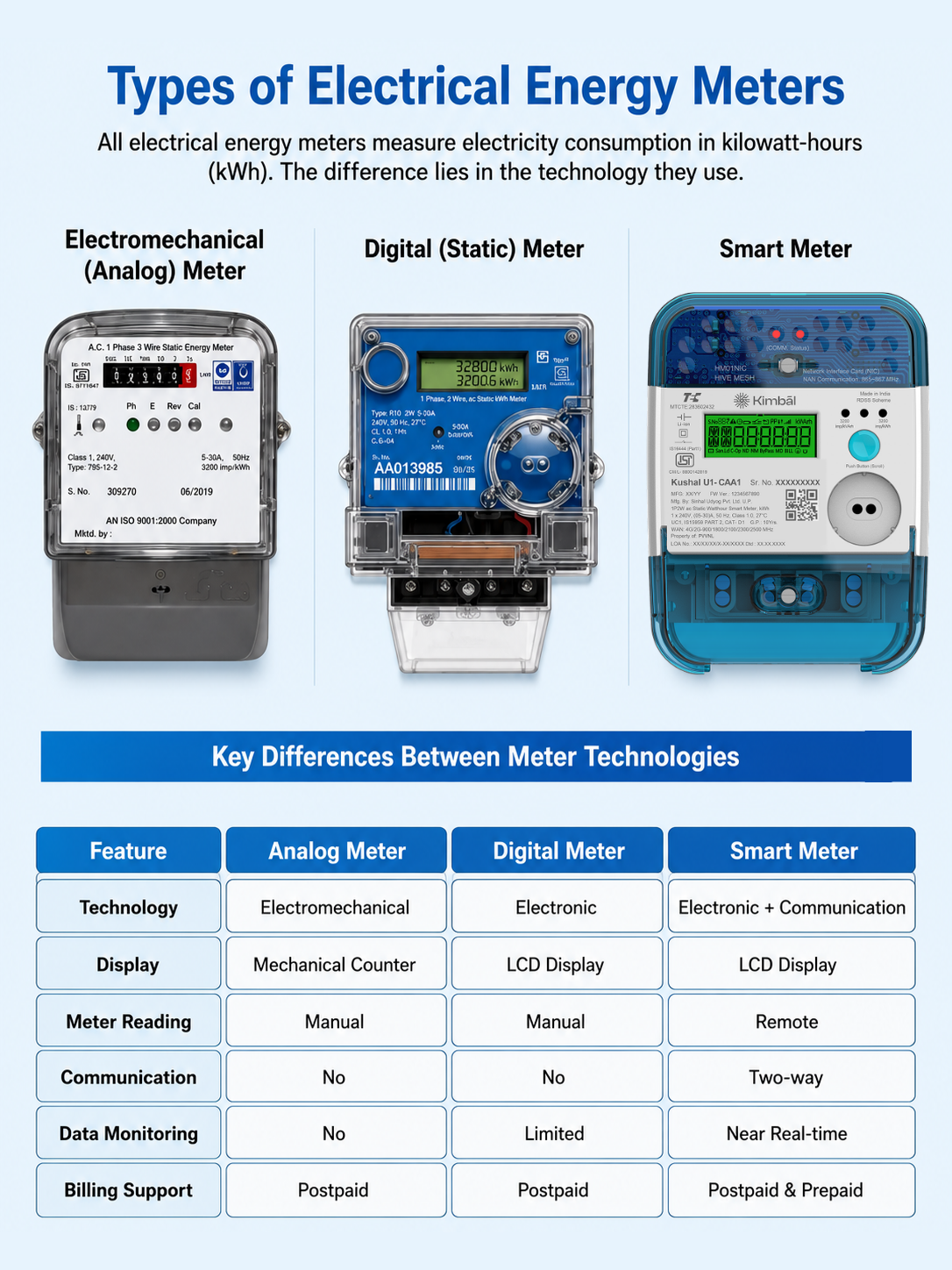
In India, electricity meters can generally be classified in three different ways: the technology they use, the billing model they support, and the type of power supply they are designed for. Understanding these categories makes it easier to identify the meter installed at your home or business and the features it offers.
Whatever type you have, whether electromechanical, digital, or smart, all of them fall under the umbrella terms electrical energy meter and electricity meter. The type only describes the technology inside; it doesn’t change what to call the device.
1. Electromechanical Meter (Analog Meter)
An electromechanical meter, also known as an analog meter, is the oldest type of electricity meter and you can still find it in some older homes and buildings. It uses a rotating aluminium disc inside a glass enclosure. As electricity is consumed, the disc spins, and a mechanical counter records the total energy used.
Because these meters cannot communicate electronically, someone must visit the property to read the meter manually. They also do not support modern features such as prepaid billing, remote monitoring, or automatic meter reading.
2. Digital Meter
A digital meter replaces the rotating disc with electronic circuits and a digital display. Instead of relying on moving parts, it calculates electricity consumption electronically and displays the reading on a screen, making it easier to read and generally more accurate than an analog meter.
Although digital meters improve measurement accuracy and reliability, most still require manual meter readings in many installations. Unlike smart meters, they cannot automatically send consumption data to the electricity distribution company.
3. Smart Meter
A smart meter measures electricity just like any other electricity meter, but it also communicates securely with the electricity distribution company. Instead of waiting for someone to visit your property, the meter automatically sends consumption data at regular intervals.
This communication capability enables features such as automatic meter reading, near real-time electricity consumption monitoring, prepaid billing, remote connection and disconnection, and faster outage detection. Meters measure electricity the same way regardless of type, but smart meters add convenience, transparency, and operational efficiency on top.
A smart meter is still an electrical energy meter or electricity meter, at its core. The word “smart” simply describes the technology added on top, not a different device.
Learn more: Smart Meters in India Explained: Benefits, Prepaid Model, and RDSS Guide (2026)
1. Prepaid Meter
A prepaid meter works much like a prepaid mobile phone connection. You add credit to the meter before using electricity, and the available balance decreases as you consume electricity. In India, utilities typically deploy prepaid meters as smart meters, allowing consumers to recharge digitally, monitor their remaining balance, and better manage electricity expenses.
2. Postpaid Meter
A postpaid meter records electricity consumption throughout a billing cycle. At the end of the cycle, the electricity distribution company calculates the bill based on the recorded meter reading and the applicable tariff. This remains the most common billing model for residential, commercial, and industrial consumers across India.
1. Single-Phase Meter
Homes, apartments, and small shops commonly use single-phase meters, which are built for lower electricity loads. It works with a single-phase power supply, the standard electricity connection for most residential consumers in India.
2. Three-Phase Meter
Larger homes, commercial buildings, factories, and industrial facilities commonly use three-phase meters, which are built for higher electricity loads. It measures electricity across three separate power phases, enabling it to support significantly greater power demand than a single-phase meter.
India’s electricity system serves millions of consumers across cities, towns, and villages. Managing such a large network requires timely information, accurate billing, and better visibility into electricity usage. To support this transformation, the Government of India launched the Revamped Distribution Sector Scheme (RDSS). One of its key objectives involves deploying smart meters across the country to modernise electricity distribution and improve consumer services. In practice, this means smart meters solve several problems at once, for both utilities and the people paying the bill. Smart meters help:
For electricity consumers, the biggest advantage is simple: more information about how and when electricity gets used.
Learn more: Smart Meters in India Explained: Benefits, Prepaid Model, and RDSS Guide (2026)
A smart meter does much more than measure electricity. It helps electricity consumers become active participants in managing their electricity usage. Benefits include:
Reading your electricity meter is easier than many people think.
On most digital and smart meters, the display cycles through different values automatically, so you do not need to press any buttons in most cases. Simply wait a few seconds and the screen will move to the next reading on its own. Look for:
Comparing readings over time helps you understand seasonal changes in electricity usage. Alternatively, you can also use the mobile app given to you by your DISCOM or utility to learn more about your consumption.
Learn more: How to Read Your Smart Meter Display: 2026 Guide for electricity consumers in India
Electricity meters come with a few common misunderstandings. Here are some of the most frequent ones, cleared up.
Myth: Electrical energy meter and electricity meter are different.
Fact: They usually refer to the same device.
Myth: Smart meters consume extra electricity.
Fact: Smart meters measure electricity consumption. Their own power requirement is extremely small and is never charged in the consumers bill, the DISCOM or utility pays for it.
Myth: Electricity units and kilowatts are the same.
Fact: Kilowatt (kW) measures power. Kilowatt-hour (kWh) measures energy consumed over time.
Myth: My electricity bill depends on the type of meter.
Fact: Your bill depends on the electricity you consume, your usage pattern and the applicable tariff in that area.
Learn more: 1 Unit Electricity Cost in India (2026): State-Wise Tariff & Bill Calculation Guide
Simple Tips to Manage Electricity Consumption
Now that you understand how your electricity meter works, you can put that knowledge to use. A few small habits can go a long way toward lowering your electricity usage. Here are a few practical habits:
Small changes over time can make a noticeable difference in electricity usage.
Whether you call it an electrical energy meter or an electricity meter, the purpose stays the same: measuring the amount of electricity you use.
What has changed over the years is the technology behind the meter. Analog meters introduced electricity measurement to millions of homes. Digital meters improved accuracy and readability. Today, smart meters take the next step by strengthening the grid and giving consumers greater visibility, convenience, and control over their electricity usage.
As India continues modernising its power sector through initiatives like RDSS, understanding your electricity meter will help you read your bill with confidence, monitor your consumption more effectively, and make informed decisions about your energy use.
What is an electrical energy meter?
An electrical energy meter measures the amount of electricity consumed over a period. Electricity distribution companies use this reading to prepare your electricity bill.
Is an electrical energy meter the same as an electricity meter?
Yes. In most situations, both terms refer to the same device.
What does an electricity meter measure?
It measures electrical energy consumed in kilowatt-hours (kWh).
What is one unit of electricity?
One unit equals one kilowatt-hour (1 kWh).
Learn more: What is 1 Unit of Electricity? kWh Explained Simply
How does a smart meter differ from a digital meter?
Unlike a digital meter, a smart meter can automatically communicate meter readings and support advanced services like prepaid billing and consumption monitoring.
Why is India installing smart meters?
India is deploying smart meters under RDSS to modernise electricity distribution, improve billing efficiency, and provide better services to consumers.
Learn more: Smart Meters in India Explained: Benefits, Prepaid Model, and RDSS Guide (2026)
Can I check my electricity usage myself?
Yes. You can read your meter directly through the digital display on your smart meter. Many smart meter deployments also allow consumers to view usage through mobile or web-based platforms.
Learn more: How to Read Your Smart Meter Display: 2026 Guide for electricity consumers in India
How often should I check my electricity meter?
Checking your meter once every week helps you understand your electricity consumption better.
Does every home have the same type of electricity meter?
No. Some homes still have analog or digital meters, while many consumers now have smart meters under the RDSS.
Can smart meters support rooftop solar systems?
Many smart meter deployments can work alongside net metering arrangements, subject to applicable utility regulations and technical requirements.
What is the difference between kW and kWh?
Kilowatt (kW) measures power, or how fast electricity is being used. Kilowatt-hour (kWh) measures energy, or the total amount used over time.
Learn more: What is a “Unit” in electricity? Meaning, kWh Calculation & Electricity Bill Guide
How accurate are electricity meters?
Electricity meters sold in India must meet accuracy standards set by the Bureau of Indian Standards (BIS) before they can be installed for billing purposes.
Which type of electricity meter is commonly used in homes?
Most Indian homes use single-phase meters, since residential electricity loads are generally lower than commercial or industrial loads.
Can a smart meter replace my existing electricity meter?
Yes. Under RDSS, electricity distribution companies are replacing many existing analog and digital meters with smart meters.
How do I recharge a prepaid smart meter?
Most prepaid smart meters can be recharged through your utility’s mobile app, website, or authorised recharge centres, like a prepaid mobile connection.
Learn more: How to Recharge Your Smart Meter Online and Offline in India (2026 Guide)
What should I do if my electricity meter display shows an error or warning symbol?
If your meter shows a warning symbol, note down what is displayed and contact your electricity distribution company. Avoid attempting to open or repair the meter yourself. You can reach out to your state electricity provider at 1912 (national helpline number for all states) for recharge support, complaints, or queries.
Published on 13 October 2026
Published on 7 October 2026

Published on 6 October 2026
Your email address will not be published. Required fields are marked *