
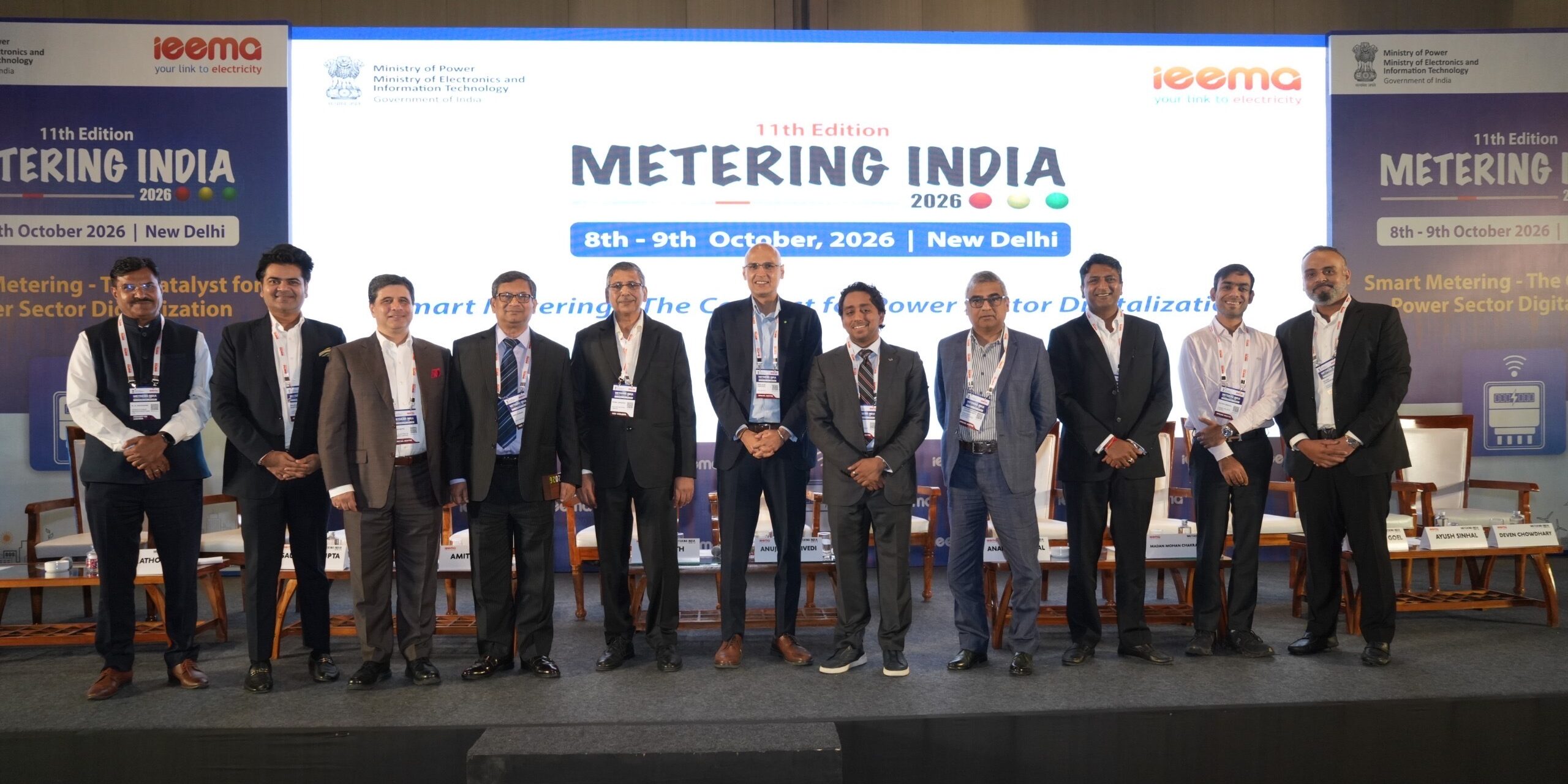
Kimbal Participates in Metering India 2026, Highlighting the Need to Strengthen India’s Smart Metering Ecosystem
Published on 13 October 2026




Smart meters are surrounded by various claims and concerns about electricity bills, health, privacy and power disconnection. This guide separates facts from misconceptions and explains how smart meters work, how they measure electricity and what they mean for consumers in India.
Smart meters are becoming an increasingly common part of India’s electricity infrastructure. As more households, shops and businesses move from traditional meters to smart meters, questions about electricity bills, safety, privacy, prepaid metering and power supply are also increasing. Some concerns come from genuine questions. Others are based on social media posts, word of mouth or misunderstandings about how smart meters work. So, what is actually true? This guide answers the most common questions about smart meters and separates smart meter myths from facts in simple terms.
Myth 1: Do smart meters increase electricity bills?
Fact: No. A smart meter does not increase your electricity tariff or decide how much you are charged. It measures your electricity consumption, while your bill is calculated using your applicable tariff and billing rules.
A change in your bill after a smart meter is installed does not necessarily mean that the meter is charging you more. Your bill can change because of higher electricity consumption, a change in tariff, correction of previous estimated readings, billing-cycle differences or other applicable charges.
A smart meter records electricity consumption electronically and communicates the meter data to the electricity distribution company. This reduces dependence on manual meter readings and estimated consumption.
In simple terms: the meter measures your consumption; the applicable tariff determines what you pay.
Myth 2: Does a Smart Meter Use Electricity and Increase My Bill?
Fact: Yes, a smart meter consumes a small amount of electricity to operate, but the cost of this electricity is borne by the utility and is not added to the consumer’s electricity bill.
Like other electronic devices, a smart meter requires power to operate its display, measurement circuitry, clock and communication functions.
However, the electricity consumed by the smart meter is not charged as part of the consumer’s electricity consumption. The cost of operating the meter is borne by the electricity utility.
Learn more: How to Read Your Smart Meter Display: 2026 Guide for electricity consumers in India
Myth 3: Are smart meters safe?
Fact: Yes. Smart meters supplied in India are required to meet applicable safety, performance and conformity requirements.
Smart meters undergo specified testing for parameters such as electrical safety, measurement performance, environmental conditions and electromagnetic compatibility.
In India, IS 16444 specifies requirements for smart meters. The Smart Meters (Quality Control) Order, 2023 requires covered smart meters to conform to the applicable Indian Standard and bear the BIS Standard Mark under the applicable certification scheme. Smart-meter specifications issued by the Central Electricity Authority (CEA) also include requirements related to measurement, communication, tamper-event detection, power-event alarms and other functions.
Myth 4: Are Smart Meters Harmful to Health?
Fact: No. Smart meters use the same type of radio-frequency waves used by everyday wireless technologies, including Wi-Fi routers, mobile phones and Bluetooth devices.
Smart meters communicate wirelessly by using radio-frequency (RF) signals to send electricity consumption data to the electricity distribution system. Like Wi-Fi routers, they use RF technology for communication. However, the exact frequency and communication technology used can vary depending on the smart-meter deployment.
In India, smart meters can use RF Mesh or cellular communication technologies. Kimbal’s smart meters, for example, support RF Mesh and cellular communication depending on the deployment requirements.
Myth 5: Do smart meters invade my privacy?
Fact: Smart meters collect electricity consumption data, so data privacy is an important consideration, but the meter does not record conversations, images or activities inside your home.
A smart meter records information related to electricity consumption, such as how much electricity is used and, depending on the system configuration, when it is used. This information helps the electricity distribution company with functions such as:
If you have questions about your data, check your DISCOM’s policy to understand what information is collected, why it is collected, how it is used and who can access it.
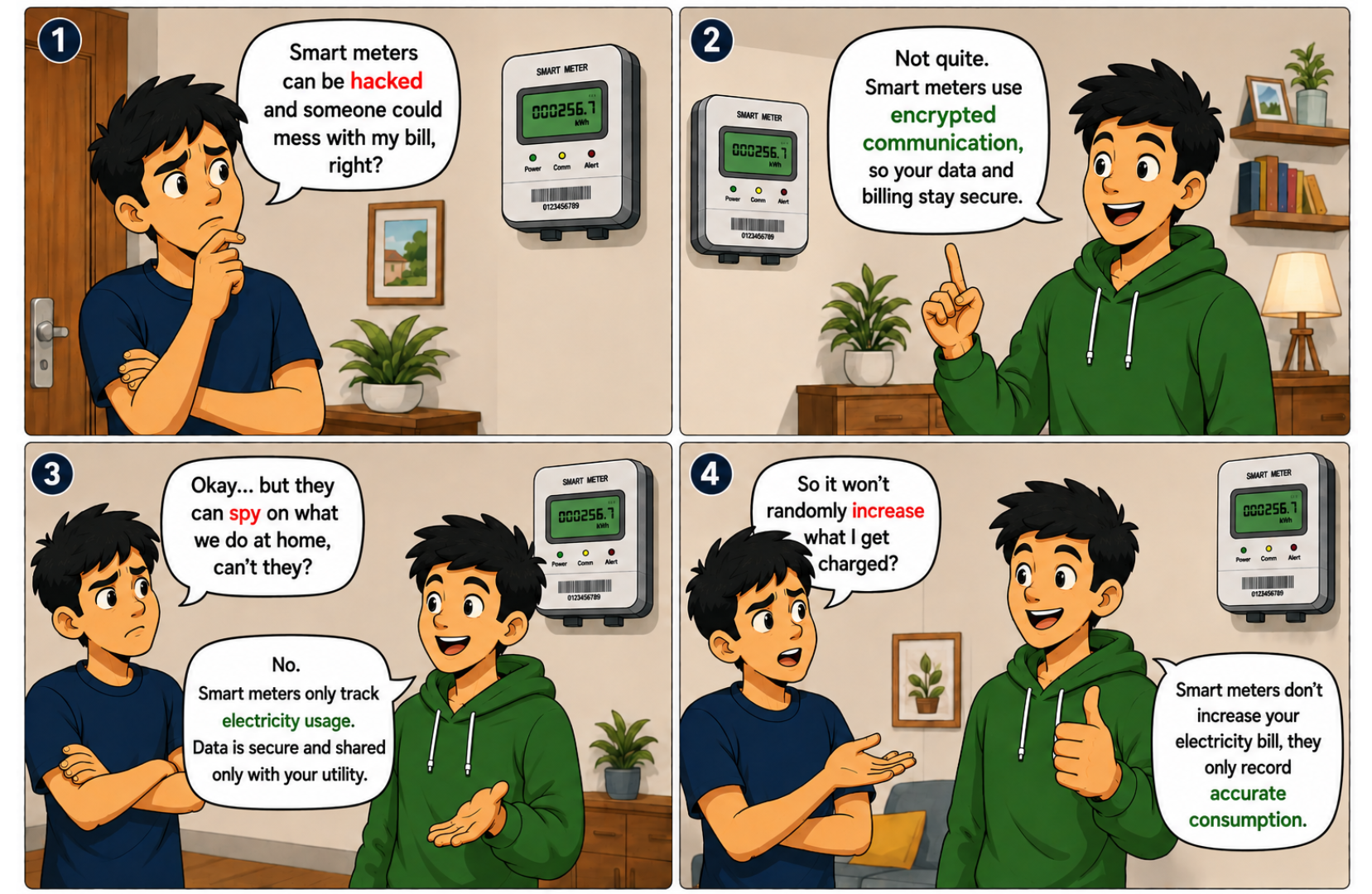
Myth 6: Can smart meters be hacked easily?
Fact: Smart-meter systems use multiple security measures to protect meter data and communications, so hacking a smart meter is not as simple as connecting to a home Wi-Fi network.
Depending on the system, security measures can include:
No connected technology can honestly be described as completely immune to cyber threats. The important point is that smart-meter systems are designed with security controls to reduce the risk of unauthorised access and data manipulation.
Learn more: Smart Grid vs Traditional Grid: Key Differences, Benefits & the Future of Electricity
Myth 7: Do smart meters stop working during a power cut?
Fact: A smart meter cannot continue normal measurement and communication without power, but many smart-meter systems can help the electricity distribution company detect outages automatically.
Depending on the meter and communication system, a smart meter may send a last-gasp message when it detects a loss of supply. When communication is restored after power returns, the meter can also communicate again with the utility system. This information can help the electricity distribution company identify the location and timing of outages and improve restoration efforts.
Myth 8: Can a smart meter disconnect my electricity automatically?
Fact: A smart meter does not independently decide to disconnect your electricity, although some smart meters can support remote connect or disconnect functions when authorised by the electricity distribution company.
Some smart-meter specifications include an integrated load-limiting switch or relay and support remote control functions. Whether and how such a function is used depends on the meter, the utility’s system and the applicable rules and consumer arrangement.
The important distinction is this: The smart meter executes an authorised function. It does not independently decide that your electricity should be disconnected.
Myth 9: Are smart meters and prepaid meters the same?
Fact: No. Smart metering and prepaid metering refer to different things.
A smart meter describes the meter’s measurement, communication and other smart capabilities. Prepaid metering describes a billing arrangement in which consumers pay or recharge before consuming electricity, subject to the applicable rules.
A smart meter can support prepaid functionality, but a smart meter and a prepaid meter are not interchangeable terms. This distinction is particularly important in India because the country’s smart-metering programme includes prepaid smart-metering as a major component. The RDSS framework envisages prepaid smart metering alongside broader distribution-system modernisation.
Learn more: How to Recharge Your Smart Meter Online and Offline in India (2026 Guide)
Myth 10: Are smart meters useful only for electricity companies?
Fact: No. Smart meters can provide benefits to consumers as well as electricity distribution companies and the wider electricity grid.
For consumers, smart meters can provide better visibility into electricity consumption and reduce dependence on estimated readings. Depending on the system and services provided by the DISCOM, consumers may be able to:
For electricity distribution companies, smart meters can support remote meter reading, energy accounting, outage management, loss reduction and demand analysis.
Learn more: Smart Metering Companies in India: A Complete Guide for Electricity Consumers
Myth 11: Are smart meters only used in cities?
Fact: No. Smart-meter deployment is not limited to major cities.
India’s smart-metering programmes cover consumers and electricity infrastructure across different types of locations.
Under RDSS, smart-metering works have been sanctioned across 45 distribution utilities in 28 States and Union Territories, covering nearly 20 crore consumers, along with distribution-transformer and feeder metering. The actual rollout schedule varies between states, DISCOMs and projects. This means a consumer’s location and local rollout plan determine when a smart meter is installed.
Myth 12: Do smart meters need frequent maintenance?
Fact: No. Smart meters are designed for long-term operation and can support remote monitoring and diagnostics, reducing the need for routine physical visits.
Smart-meter systems can monitor meter performance and identify certain faults or abnormal conditions remotely. Depending on the meter and system, software or firmware updates can also be carried out remotely. Central Electricity Authority (CEA) smart-meter specifications include remote firmware upgrade as a functional requirement. Physical maintenance may still be required if a meter develops a fault or needs to be inspected or replaced.
Myth 13: Can a smart meter give incorrect readings?
Fact: Like any measuring device, a smart meter must meet specified accuracy requirements, but no meter should be assumed to be completely immune to faults.
Smart meters supplied in India are required to meet applicable standards and testing requirements for measurement accuracy and other performance parameters. IS 16444 includes requirements relating to smart-meter measurement and functional performance.
If you believe your meter reading or electricity bill is incorrect, contact your DISCOM and follow the applicable meter-testing and consumer grievance process. Dial 1912 to reach the national toll-free electricity helpline used across India to report power outages, transformer faults, billing errors, and emergency electrical hazards to your local power distribution company.
A smart meter is a digital electricity meter that measures consumption and automatically communicates usage data to the electricity utility. Unlike traditional meters, smart meters do not depend on manual reading. They form an important part of India’s modern electricity infrastructure and play a key role in smart grid development.
Learn more: Smart Meter vs Traditional Meter: Key Differences Explained (2026 Guide)
A smart meter measures electrical parameters such as voltage and current to calculate electricity consumption, which is recorded in kilowatt-hours (kWh). Here’s the basic relationship:
Voltage + Current → Power → Energy Consumption → kWh
For example, if a 1,000-watt appliance operates for one hour: 1,000 watts × 1 hour = 1 kWh. Your electricity bill is based on the amount of electrical energy consumed, measured in kWh or units.
Learn more: What is a “Unit” in Electricity? Meaning, kWh Calculation & Electricity Bill Guide
Smart meters provide better electricity-consumption data that can help consumers manage usage and help electricity distribution companies operate the distribution network more efficiently.
Smart meters benefits for consumers:
The Ministry of Power has highlighted near-real-time consumption visibility through mobile applications as one of the consumer benefits associated with smart metering under RDSS.
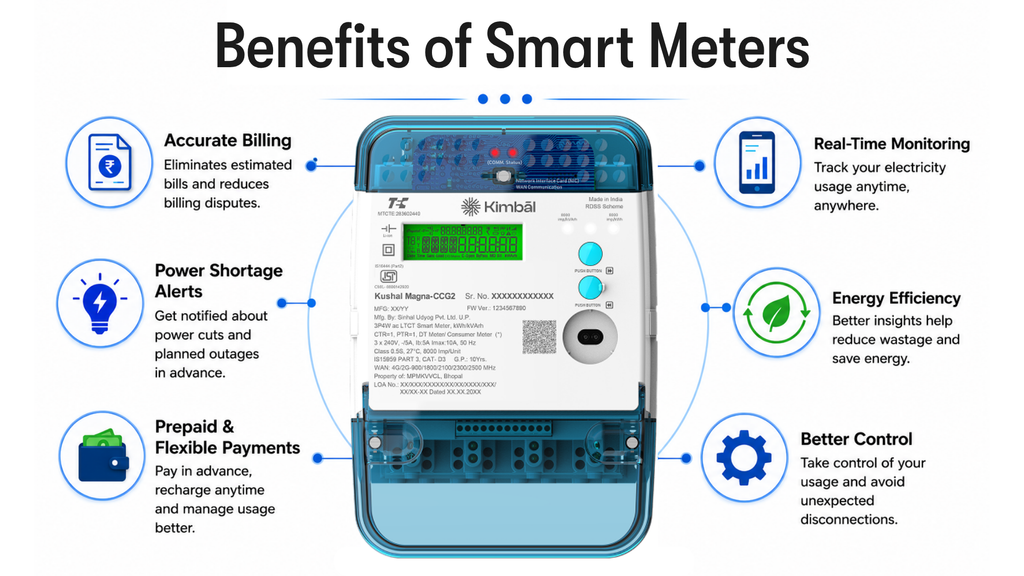
Smart meter benefits for DISCOMs and utilities:
Smart meters benefits at the grid level:
Smart meters are therefore one part of a broader digital electricity-distribution system.
Learn more: Smart Meters in India Explained: Benefits, Prepaid Model, and RDSS Guide (2026)
The Revamped Distribution Sector Scheme (RDSS) is a Government of India initiative focused on improving the operational efficiency and financial sustainability of electricity distribution companies, with smart metering forming an important part of the programme.
The scheme was launched in July 2021. Its objectives include reducing Aggregate Technical and Commercial (AT&C) losses and improving the financial sustainability and operational efficiency of distribution utilities.
Smart metering is one component of RDSS alongside wider distribution-infrastructure improvements.
The scheme envisages smart metering at the consumer, distribution-transformer and feeder levels. As of 31 December 2025, the Government reported that, 6 crore smart meters had been installed across the country under RDSS and various other schemes.
Learn more: Revamped Distribution Sector Scheme (RDSS): State-wise Update and Key Highlights 2026
India is adopting smart meters to improve electricity billing, energy accounting, distribution efficiency and consumer visibility while supporting the modernisation of the power-distribution system. Better and more timely meter data can help DISCOMs understand where electricity is being consumed and identify losses or unusual patterns.
For consumers, smart meters can support better consumption visibility and more convenient access to electricity-use information. For the wider distribution system, smart metering can contribute to improved energy accounting, demand analysis and operational efficiency.
RDSS aims to bring pan-India AT&C losses down to 12–15%, while broader reforms under the scheme are intended to improve the financial sustainability of distribution utilities.
Yes. Smart-meter deployment extends beyond major cities, although the timing and scale of rollout depend on the local DISCOM and project. RDSS smart-metering works have been sanctioned across multiple States and Union Territories and cover consumers across different types of locations.
The objective is not simply to replace meters in urban households. Smart metering forms part of a broader effort to modernise electricity distribution infrastructure and improve energy accounting across the network.
A smart meter is primarily a more connected way of measuring and managing electricity consumption. It does not set your electricity tariff, and it does not independently decide how much you pay. It measures electricity consumption and can communicate that information to the electricity distribution system.
Smart meters can help consumers understand their electricity usage while helping DISCOMs improve meter reading, energy accounting, outage management and distribution operations.
In India, smart metering is also an important part of the broader modernisation of the electricity distribution sector under RDSS. The best way to understand a smart meter is not through rumours, but through the technology itself: what it measures, what data it communicates, how that data is protected and how the electricity distribution company uses it.
Do smart meters increase electricity bills?
No. A smart meter does not increase your electricity tariff. It measures your electricity consumption, while the applicable tariff and billing rules determine your bill.
Learn more: 1 Unit Electricity Cost in India (2026): State-Wise Tariff & Bill Calculation Guide
Do smart meters consume electricity?
Yes. Smart meters require a small amount of electricity to power their electronic components and communication functions. However, the cost of operating the meter is borne by the utility and is not added to the consumer’s electricity bill.
Can I monitor my electricity usage with a smart meter?
Yes, where the DISCOM provides the relevant service. Consumers may be able to view consumption through a mobile application, in-meter display or another consumer interface.
How often does a smart meter record electricity usage?
The recording interval depends on the meter and system configuration. Smart-meter systems can record consumption at regular intervals rather than relying only on periodic manual readings.
What is the difference between a smart meter and a digital meter?
A digital meter displays electricity consumption electronically, while a smart meter adds communication and other smart functionalities. Smart meters can communicate meter data to the utility’s AMI system.
Learn more: Electrical Energy Meter vs Electricity Meter: Key Differences Explained (2026 Guide)
Are smart meters safe?
Yes. Smart meters supplied in India are required to comply with applicable standards and regulatory requirements. IS 16444 specifies requirements for covered smart meters, and the Smart Meters Quality Control Order requires applicable products to conform to the relevant Indian Standard.
Are smart meters harmful to health?
No. Smart meters use radio-frequency signals, the same type of wireless technology used by everyday devices such as Wi-Fi routers, mobile phones and Bluetooth devices. These radio signals are used for wireless communication and operate within applicable technical and regulatory requirements.
Can smart meters be hacked?
Smart-meter systems use security measures such as encryption, authentication and access controls to protect meter data and communications. No connected system should be described as completely immune to cyber threats, but smart-meter networks are designed with security controls to reduce these risks.
How is smart-meter data protected?
Smart-meter data is protected through encryption, authentication, access controls and applicable data-protection requirements. The exact controls depend on the utility and AMI system.
Can a smart meter see what I am doing at home?
No. A smart meter measures electricity consumption data; it does not have a microphone or camera to monitor activities inside your home. However, detailed electricity-use patterns can provide information about your electricity consumption behaviour.
Do smart meters need Wi-Fi?
No. Smart meters do not need your home’s Wi-Fi to communicate with the electricity distribution system. They use a dedicated communication technology, such as RF Mesh or cellular communication, depending on the utility’s AMI deployment.
What happens to a smart meter during a power cut?
The meter cannot continue normal operation without power, but some smart-meter systems can send an outage or “last-gasp” message when supply is lost. This can help the utility identify outages.
Can a smart meter disconnect electricity remotely?
Some smart meters support remote connect or disconnect functions, but these operate through authorised utility systems and applicable rules. The meter does not independently decide to disconnect a consumer.
Do smart meters need maintenance?
Smart meters generally require limited routine physical maintenance. Remote monitoring and diagnostics can reduce the need for routine site visits, although physical inspection or replacement may be required if a fault occurs.
How long does a smart meter last?
The service life of a smart meter depends on the manufacturer, model, operating conditions and applicable standards. Your DISCOM can provide the relevant information for the meter installed at your premises.
Who installs a smart meter?
Smart meters are installed by authorised personnel working for or on behalf of the electricity distribution company, following applicable installation and safety requirements.
Are smart meters and prepaid meters the same?
No. Smart metering refers to the meter’s technology and capabilities, while prepaid metering refers to the billing arrangement. A smart meter can support prepaid functionality, but the two terms do not mean the same thing.
Are smart meters mandatory in India?
The answer depends on the applicable government programme, state and DISCOM rollout and the consumer category. Consumers should check with their local electricity distribution company for the rules applicable to their connection.
Can a smart meter give incorrect readings?
Smart meters are required to meet applicable accuracy requirements, but any meter can potentially develop a fault. If you believe your reading is incorrect, contact your DISCOM and use the applicable meter-testing or grievance process.
Can smart meters detect electricity theft?
Smart meters can help identify unusual consumption patterns and tamper events. CEA smart-meter specifications include tamper-event detection, recording and reporting as a functional requirement.
Are smart meters used in rural India?
Yes. Smart-metering works under India’s distribution-modernisation programmes extend across States and Union Territories and are not limited to major cities. The timing of installation depends on the states’ local rollout plan.
Published on 13 October 2026

Published on 7 October 2026
Published on 6 October 2026
Your email address will not be published. Required fields are marked *